

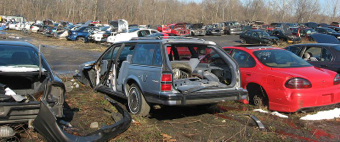
 Ansonia Aldermen are considering a law that gives city officials the power to tow “abandoned, inoperable, or unregistered” motor vehicles from residents’ private property.
The new ordinance is part of the city’s push to reduce blight.
Aldermen this year strengthened the local anti-blight law with a measure allowing the city to send crews onto residents’ properties to clean them up — after giving the owners proper notice.
Aldermen on Tuesday (Dec. 9) voted to approve the new ordinance, but will need to take it up again next month because of procedural issues before it will go into effect.
The Ordinance
The new ordinance works much the same way as the blight law.
It prohibits “any abandoned, inoperable or unregistered” motor vehicles on a property owner’s land “except in a completely enclosed and secured area.”
If the anti-blight officer finds a vehicle in violation of the ordinance, notice will be sent to the owner of the property giving them 30 days to remove the vehicle.
Property owners who fail to remove such vehicles would face a $50 fine, and the cost of the city arranging to tow the vehicle, which would be recorded in liens on the property.
Owners wishing to contest the fine can request a hearing before a Zoning Enforcement Appeals Officer within 15 days of being cited.
Article continues after the document.
Discussion
John Marini, the city’s corporation counsel, asked Aldermen to pass the new law at their regularly monthly meeting Tuesday (Dec. 10), saying abandoned cars have become a safety hazard in the city.
“For a long time we’ve had to stand by while violators abuse the laws, (and) have numerous unregistered or abandoned vehicles on their property,” Marini said. “Oftentimes they become a safety hazard with children or animals playing inside. This (law) gives the city the ability to have a system to get those vehicles off the property in a timely fashion while still affording the owners due process protections.”
Marini couldn’t provide an estimate of just how many properties have abandoned vehicles on them.
The Valley Indy emailed the city’s anti-blight officer, David Blackwell Sr., Thursday asking how frequently he receives complaints about clunkers on private property.
First Ward Republican Charles Stowe said he was hesitant to vote for the ordinance because of the sanctity of personal property rights, but decided that blight was such a prevalent problem he decided to vote yes.
Daniel Evans, a Republican from the Seventh Ward, said the new law goes too far.
“I’ve thought about this a long while, about personal property rights versus the good of the community,” Evans said. “At least for me this is too much. Personal property rights are going to trump in my case.”
The Aldermen then approved the law by a 9-1 vote, with Evans the sole member in opposition.
Let’s Try Again Next Month
Marini told Aldermen Tuesday that if at least 11 of their full 14-member complement had been present for the meeting and voted yes for the measure, it could go into effect immediately.
But only 10 Aldermen were in attendance, with one of them voting against the ordinance.
If you don’t like the proposed law, you’ll have the chance to come to City Hall and tell the Aldermen face to face, because Evans’ no vote, coupled with the missing Aldermen, forced the Aldermen to hold a public hearing.
“An ordinance can pass with a majority, but if there are 11 votes in concurrence on it you can pass the ordinance without the need for the public hearing,” he said. “If it’s a majority-only ordinance, it still passes, but it would require a public hearing before taking effect.”
Section 148 of the city’s charter, titled “Passage of ordinances; when ordinances effective,” actually pegs the number of Aldermen needed for a new law to go into effect immediately at 12.
The charter section also says new ordinances passed with fewer than 12 votes can’t go into effect “until it shall have been referred to a suitable committee and reported by such committee, after public hearing.”
But the Aldermen’s Ordinance Subcommittee hasn’t met since July.
Marini said Thursday (Dec. 11) that the committee will take up the ordinance at a meeting to be scheduled this month.
Assuming it gets the committee’s endorsement, the full Board of Aldermen would then hold a public hearing, likely prior to their next regular meeting Jan. 13, before voting on it again during the meeting itself.
Will any of this help out tax coffers?
How about a directive to review all the cars with out of state plates parked for YEARS in our neighborhoods. State of Connecticut DMV states the following:
Once you have established residency in Connecticut, you have 60 days to transfer your vehicle registration to this state, License is 30 days.
There has been little to no enforcement here.
I pass 3 or 4 cars every day with out of state plates that have been living here for over a year.
We have a police car that has the equipment to read plates.
Yes, it will help with our taxes. The towing is part of an overall effort to identify unregistered vehicles and stem the loss of tax revenue. The administration took office with an 80% MVA collection rate. Thats abysmal. It needs to be improved.
The towing aspect comes in only when the vehicle constitutes a zoning violation and will be enforced pursuant to the same ordinance framework that most other towns use. Importantly, we are enforcing old laws, not making up new things to outlaw. Unregistered vehicles are illegal pursuant to our existing zoning code.
The new towing law is new for Ansonia, but not new for the rest of Connecticut. Towns and cities like Milford, Stratford, New Haven and many more have done this for years, with great results.
The towing is also part of the general clean-up effort spearheaded by the new blight department. The effort is funded by violations and seeks to enhance property values city wide by addressing long neglected condition, many of which do involve private property and therefore require an enforcement mechanism that respects private property rights by affording ample due process.
On top of that, the goal is remediation – not punishment – and you’ll see every effort is made to work with, not against, property owners to improve neighborhoods.
The fact is that many residents have spent the last 2 decade looking across the street at the same abandoned campers, trailers, cars and trucks, full of rust and sometimes animals. The administration believes that city hall can play a role in cleaning up those situations by simply following existing laws (cgs section 14-150) and utilizing ordinances that have been reliably implemented by many other CT communities.