

(HARTFORD) — As black bear activity increases in the spring following winter denning season, the Connecticut Department of Energy and Environmental Protection (DEEP) warns residents to be “bear aware” and to do what they can to protect both their communities and bears by preventing human-bear conflicts.
Now that bears are up and about, simple steps to avoid feeding bears–such as taking down birdfeeders–will reduce the likelihood of conflicts that can lead to potential harm for both people and bears.
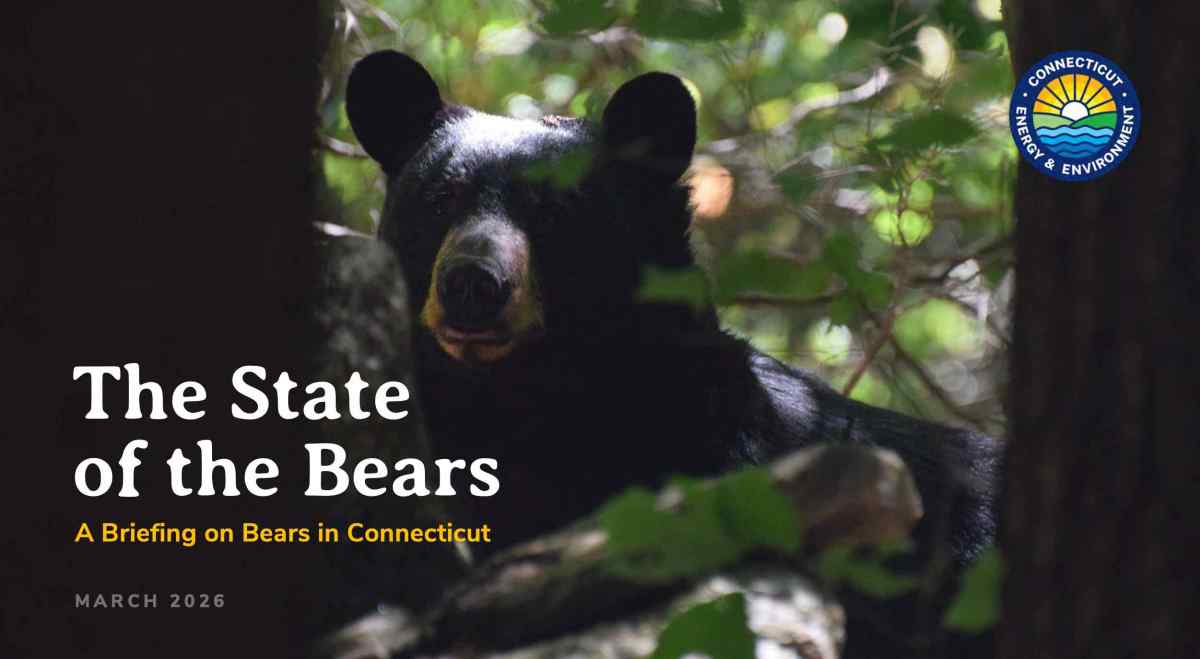
Human-bear conflicts continue to increase in Connecticut. According to DEEP’s latest “State of the Bears” Report, in 2025 bears entered or broke into homes in 18 different Connecticut municipalities. The root cause of most human-bear conflicts is access to human-associated foods (e.g., birdseed, trash, pet food, etc.) that are calorie-rich and attractive to bears.
Once black bears start to consume these human-associated foods, they become habituated (comfortable near people) and food-conditioned (associate humans, houses, and neighborhoods with food). Food-conditioned bears pose a greater risk to public safety and often cause more property damage to houses, cars, pets, and livestock than non-food-conditioned bears.
Preventing bears from accessing human food is one of the most effective ways to reduce conflicts. As the 14th most forested and fourth-most densely populated state, Connecticut offers ideal bear habitat near residential communities, making it essential for residents to take actions that allow for safe co-existence with bears.
Again, this season, officials from the National Audubon Society’s Connecticut office join DEEP to deliver a clear message: take down your birdfeeders for the spring, summer, and fall seasons. They attract bears, draw them into neighborhoods, are a major source of human-bear conflicts, and increase the risk of dangerous encounters.
Unsecured trash is another leading cause of human-bear conflicts in Connecticut. Bears are attracted to food scraps, and once they find an easy source in trash bins, they are likely to return to residential neighborhoods—putting both people and bears at risk. DEEP strongly urges residents to store trash in secure, bear-resistant locations and avoid placing bins curbside the night before collection. For added security, consider investing in bear-proof trash containers, many of which are compatible with standard waste collection services.
Human-Bear Conflicts on the Rise
DEEP’s recently released State of the Bears Report reveals a concerning decade-long rise in human-bear conflicts—not just in frequency, but in severity. Over the last six years (2020-25), bears have entered homes 265 times. In 2025 alone, 40 of these incidents were reported to DEEP. These numbers are a sharp contrast to a decade ago, when bears entered homes fewer than 10 times annually.
No matter where you live in Connecticut, you could encounter a bear, as sightings have been recorded in all 169 towns and cities. The reproducing portion of the bear population is also continuing a long-term trend of expansion into more cities and towns. Just 10 years ago, females with cubs were reported in fewer than 50 towns, while in the last three years, reports have been received from 119 different towns.
“Human-bear conflicts continue a decade-long upward trend,” DEEP Commissioner Katie Dykes said. “For the health of our bear population and the safety of Connecticut residents, it is critically important that people understand how to coexist with bears in our communities. Do your part to keep your backyard and neighborhood safe by taking advantage of the range of resources DEEP offers, including educational videos, public presentations, and electric fencing workshops.”
“In the spring and summer breeding seasons, birds rely on caterpillars, insects, and other natural food sources to feed their young. To help resolve the issue of human-bear conflict, we support the recommendations shared by DEEP to remove bird feeders—including hummingbird feeders—as a precautionary measure,” saidMichael Burger, Executive Director of Audubon Connecticut and New York. “This temporary change will not have a negative impact on the birds you love, and you can always attract birds to your home with the addition of native plants: Black-eyed susan (Rudbeckia hirta), Cardinal flower (Lobelia cardinalis), and Bee Balm (Monarda didyma) are some local favorites.”
“Black bears should never be fed, either intentionally or unintentionally,” said Jenny Dickson, Director of DEEP’s Wildlife Division. “Our latest report shows that the vast majority of human-bear conflicts are caused by unsecured trash and birdfeeders. Taking simple steps like removing birdfeeders and securing garbage can significantly reduce these encounters and help keep your neighborhood safe.”
DEEP has several tips to help you protect yourself, your neighborhood, and bears by preventing bear conflicts. They are available on DEEP’s “Living with Black Bears” webpage. DEEP has also created a video incorporating many of these best practices.
Intentional Feeding of Bears is Illegal
DEEP reminds residents that it is now illegal to intentionally feed bears. In 2023, the Connecticut General Assembly passed, and the governor signed into law Public Act 23-77, which bans the intentional feeding of potentially dangerous wildlife (such as black bears) and also provides additional ways to address increasing conflicts associated with Connecticut’s expanding black bear population. Several municipalities have also adopted ordinances implementing feeding bans which, when paired with widespread adoption of the best practices outlined below, can help reduce human-bear conflicts in Connecticut.
Protect yourself, your neighborhood, and bears by preventing human-bear conflicts.
Everyone can protect themselves, their neighborhoods and bears by preventing human-bear conflicts. The most important first steps are to remove food sources, such as bird seed and unsecured garbage:
- NEVER feed bears.
- Take down, clean, and put away bird feeders by mid-March, or even earlier during mild weather. Store the feeders until late fall and clean up spilled seed from the ground. Store any unused bird seed and suet in a location not accessible to bears, such as a closed garage. Do not store bird seed in screened porches or sheds where bears will be able to rip screens or break through windows to access the seed.
- Store garbage in secure, airtight containers inside a garage or other enclosed storage area. Adding ammonia to trash refuse before tying the bag and then on top of the bag inside the can will reduce odors that attract bears. Periodically clean garbage cans with ammonia to reduce residual odor. Put garbage for pickup outside the morning of collection and not the night before.
- Do not store recyclables in a porch or screened sunroom as bears can smell these items and will rip screens to get at them.
- Keep barbecue grills clean. Store grills inside a garage or shed.
- Supervise dogs at all times when outside. Keep dogs on a short leash when walking and hiking. A roaming dog might be perceived as a threat to a bear or its cubs. Dogs are required to be on a leash when visiting State Parks, State Forests, and Wildlife Management Areas. Check dog and leash regulations for town properties, land trusts, and other public properties before heading to those areas.
- Do not leave pet food outdoors or feed pets outside.
- Use electric fencing to protect chickens, other livestock, beehives, agricultural crops, and berry bushes.
- Avoid placing meat scraps or sweet foods, such as fruit and fruit peels, in compost piles.
What to Do if You Encounter a Bear
If you encounter a bear while in your yard or hiking, make your presence known by yelling or making other loud noises. Use a bear whistle to let bears know you are nearby. Never attempt to get closer to a bear. If a bear does not retreat, slowly leave the area. If in your yard, go into your house, garage, or other structure. If the bear persistently approaches, go on the offensive—shout, wave your arms, and throw sticks or rocks. If your dog is hiking with you, it is imperative that you keep the dog on a SHORT leash and DO NOT let it roam free – this is for the safety of your dog, yourself, and the bear. If you are in close proximity to a bear, DO NOT try to first get a photo or video. Your first priority should be getting a safe distance between yourself and the bear.
In the rare instance when a bear appears to be aggressive toward people, residents should immediately contact DEEP’s 24-hour dispatch line at 860-424-3333.
Report Bear Sightings
Bear sightings reported by the public provide valuable information to assist DEEP in monitoring changes in the black bear population. Anyone who observes a black bear in Connecticut is encouraged to report the sighting on DEEP’s website or send an email to deep.wildlife@ct.gov. Information on the presence or absence of ear tags, including tag color and numbers, is particularly valuable.
A common misconception is that a tagged bear in Connecticut has been involved in a human-bear conflict, and a bear with two ear tags was caught on two different occasions because of conflicts. Actually, every bear receives two ear tags (one in each ear) the first time it is handled by DEEP, regardless of why it was tagged. Most tagged bears have been caught as part of a project to research the state’s bear population.
More Information
To learn more about Connecticut’s black bear population, read DEEP’s current State of the Bears Report. A portion of this press release was provided by BearWise®, a program created by bear biologists and supported by State Wildlife Agencies.
