

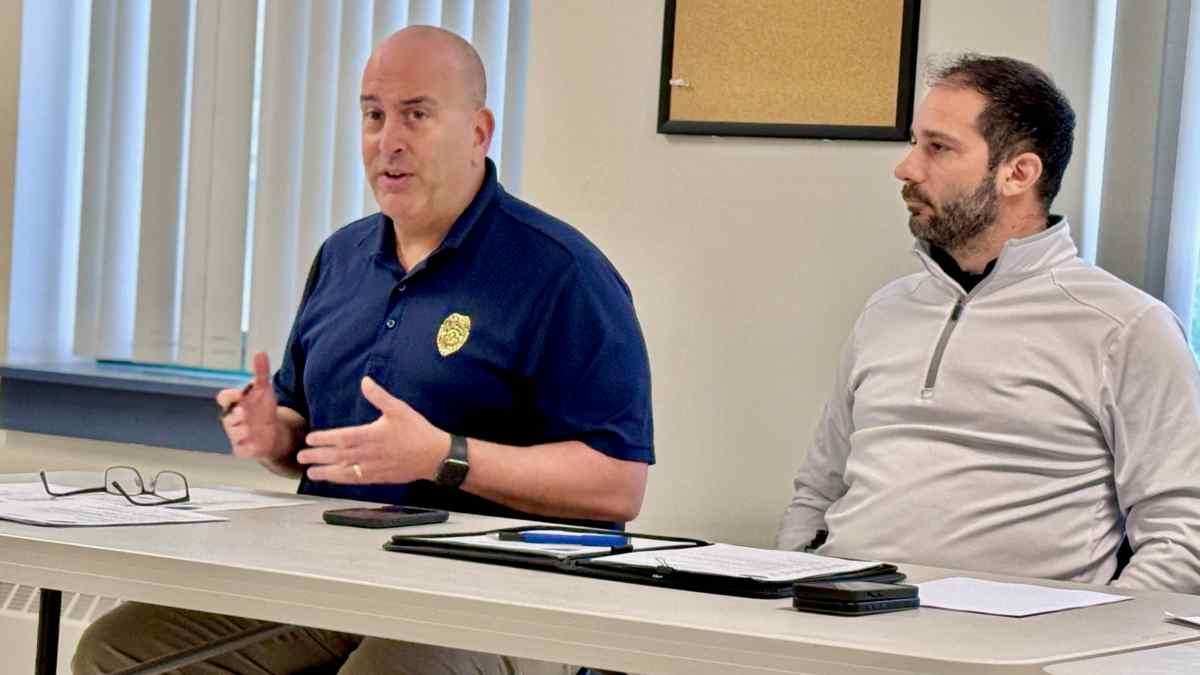
SEYMOUR – The Town of Seymour is the latest municipality looking to deploy automated cameras to curb speeding.
Members of the Board of Police Commissioners unanimously voted May 13 to give Seymour Police Chief John Bucherati permission to reach out to speed camera companies.
“With the amount of speeding complaints the police department receives, we would be remiss if we did not take a serious look at implementing automated enforcement as another way to reduce both speeding and traffic accidents,” Bucherati said. “Speeding is a problem in town. Maple Street is where we get the most complaints, and in some of the school zones.”
Story continues after the video.
Both Ansonia and Derby are also researching the issue. The cost for speed cameras and the associated infrastructure is picked up by the company, which makes money by taking a cut of the fines collected. The town also receives a cut.
Speed cameras in other parts of Connecticut have proven to be a new revenue source for towns, though short-lived because of the deterrent effect.
Deputy Police Chief Michael Fappiano said speed cams are a way to help boost safety.
“We’re exploring speed enforcement cameras as one possible tool to improve roadway safety, reduce excessive speeding and respond to ongoing resident complaints regarding unsafe driving behavior in certain areas of Seymour,” Fappiano said.
Fappiano said areas that have generated the highest number of speeding complaints are in school zones and residential areas including Maple Street, also known as state Route 313. The posted speed limit on Maple Street is 30 mph, but Fappiano said drivers exceed that.
“There’s been a good amount of accidents on Maple Street alone in recent years, as well as one fatality,” Fappiano said. “Speed is a factor.”
Fappiano said so far this year, police have made 71 motor vehicle stops for speeding on Maple Street.
“Specific locations under review include areas near schools as well as Maple Street, which is where we have received numerous complaints,” Fappiano said.
Story continues after the video.
A speed cam program would need approval from state Department of Transportation and the Board of Selectpersons, officials said.
Bucherati said the town is also required to hold a public hearing. Comments from residents must be submitted to the state.
Fappiano said the town also approved an ordinance a while back allowing for use of a speed camera enforcement program.
Seymour Police Commissioner John Duke said that while he’s not a fan of 24-7 surveillance, it’s something he thinks can help crack down on speeding.
“I’m not a fan of Big Brother watching everything we do, 365, 24-7, but there is data to back up that these things are being used effectively in most cases,” Duke said. “We can put an officer in front of Bungay school for 23 hours a day and the hour that he’s not there, that’s when we’re going to have all our violations.”
Connor Benson, a resident at the May 14 police commission meeting, spoke against the idea.
“I’m strongly opposed to it, and there are rampant privacy concerns (using this technology), as well,” he said.
The American Civil Liberties Union has raised concerns about the increasing use of surveillance technology by law enforcement in the U.S. Click here to learn more.
Police in Ansonia are considering a similar proposal, as is Derby, where officials are talking with DARCA, a leading provider of speed cam programs in the state. Derby is also moving to put cameras on school buses to deter motorists from illegally passing stopped buses.
The state approved a law in 2023 allowing municipalities to use speed cameras.
State law sets guidelines and restrictions on the programs.
Fines, for example, are capped at $50 for a first offense and $75 for subsequent offenses. Cities cannot issue fines until the cameras have been installed for at least 30 days.
In addition, a police officer would review violations before issuing a warning or fine.
Money generated from fines first goes to paying the vendor. After that, state law says the money has to go toward certain transportation and safety improvements.The speed camera programs are strong revenue generators for municipalities. The CT Mirror reported Middletown collected $1.8 million in fines between July and December of 2025. The News-Times of Danbury reported the Town of Washington issued $334,725 in fines between May and July of 2025.