

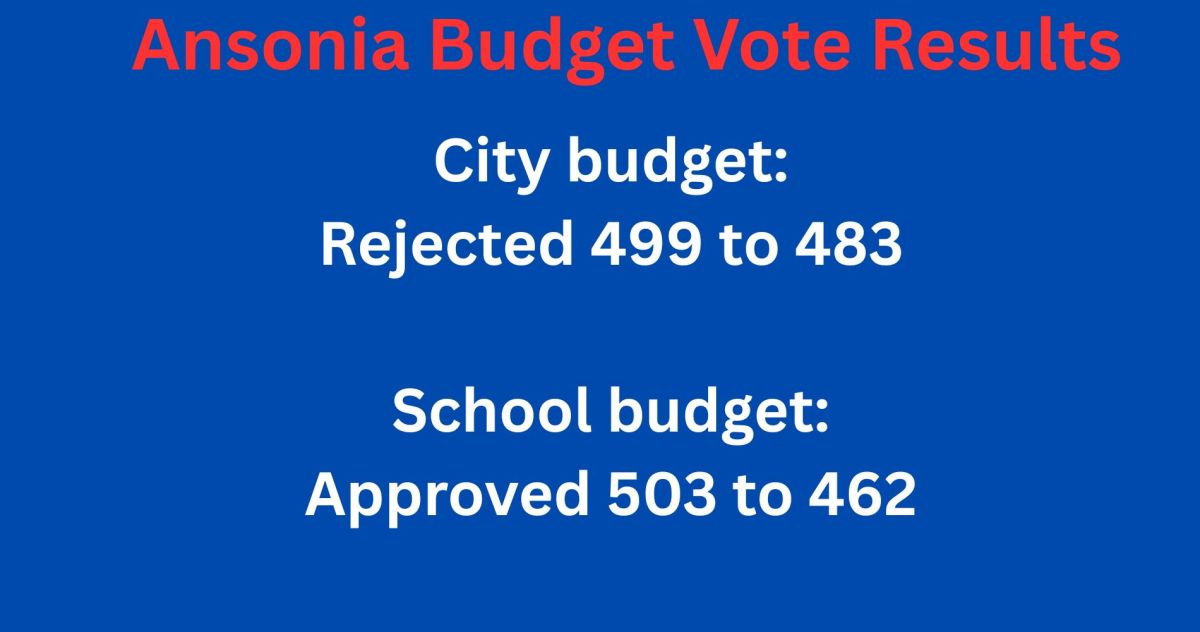
ANSONIA — Residents approved a school budget today during a citywide referendum, but rejected the city side of the budget.
The updated results (with absentee and hand-counted ballots) were as follows:
CITY BUDGET OF $30,534,066:
Yes: 483
No: 499 *
SCHOOL BUDGET OF $38,612,089:
Yes: 503 *
No: 462
The school budget is approved. The city budget will return to the Board of Aldermen for review.
The proposed budget would have increased the mill rate to 30.35 mills. That was a 1.8 mill increase over the current mill rate of 28.55 mills.
Turnout for the referendum was about 8.46 percent of eligible voters. That’s a lower turnout compared to the first budget referendum in 2025, which saw 9.7 percent participation.
The Board of Aldermen will meet at city hall Thursday (June 4) to discuss budget revisions, Alderman Jaylen Daniels said in a text. He said a time has not been solidified yet.
Check the city website for updates.
If the Aldermen approve a revised budget at that meeting, a second referendum will need to be scheduled within five days, according to the city’s charter.
Reaction
Mayor Frank Tyszka said while leaving the Armory that he would consider laying off city staff in order to make reductions to the city side of the budget. He then emailed a statement a few minutes later sharing next steps.
“Our team will immediately return to work on a Plan B, which will require some painful cuts in core services and an examination of every future cost including bond payments on capital projects. Nothing will be sacred,” Tyszka wrote in the statement.
“We respect the outcome and will get the job done,” Tyszka’s statement said.
Alderwoman Jacquelyn Daniels, who previously spoke in support of both budgets, said she was happy to see the school budget passed. She said the board will consult with city finance officials on where to tweak.
“We’ll regroup and move forward. And from there, we’ll continue on making decisions that are going to be the best for the city and the residents,” Daniels said.
Partisan Messaging Happened Before Referendum
Ansonia Democrats had campaigned for the adoption of both budgets, while Ansonia Republicans urged voters to reject the budgets in messages leading up to the referendum.
Tyszka, a Democrat, beat former Mayor David Cassetti, a Republican, in the election last November.
The Ansonia GOP Facebook page noted that, when Cassetti proposed a larger tax increase that required a referendum last year, city Democrats had campaigned against it.
“Force Ansonia City Hall to live within its means below the referendum cap, just as Democrats demanded last year,” one post said.
Tyszka had argued the tax increase was necessary due to budget decisions made under Cassetti, which Tyszka said led to multi-million dollar shortfalls in city budgets.
Those decisions included the city using money from the sale of its WPCA to fund its budgets, and a $37 million fuel cell deal approved in 2024 which hasn’t yet gotten off the ground.
The all-Democratic Board of Aldermen last week authorized Tyszka’s administration to retain an outside law firm to investigate the Cassetti’s administration’s use of city resources.
Ansonia Republicans said the rejected budget would “fund political attacks on the former Mayor.”
Tyszka has said the investigation is independent and everyone is innocent until proven guilty. Details on costs have not been shared yet.
Charter Triggered Referendum
The budget went to referendum because of charter changes approved under Cassetti’s administration in 2014.
The charter requires approval for any budget which would increase “net taxes to be collected” by more than 3 percent.
That’s the total number of tax dollars the city expects to collect in a given year. The budget sent to voters June 1 contained an increase of 8.2 percent in net taxes to be collected.
The next fiscal year begins July 1, 2026, and ends June 30, 2027.
The referendum also had two advisory questions asking whether the proposed budgets were too high or too low.
On the city side, 466 people said it was too high, with 21 people saying it was too low.
With the school budget, 398 people said the budget was too high, while 63 people said it was too low.