

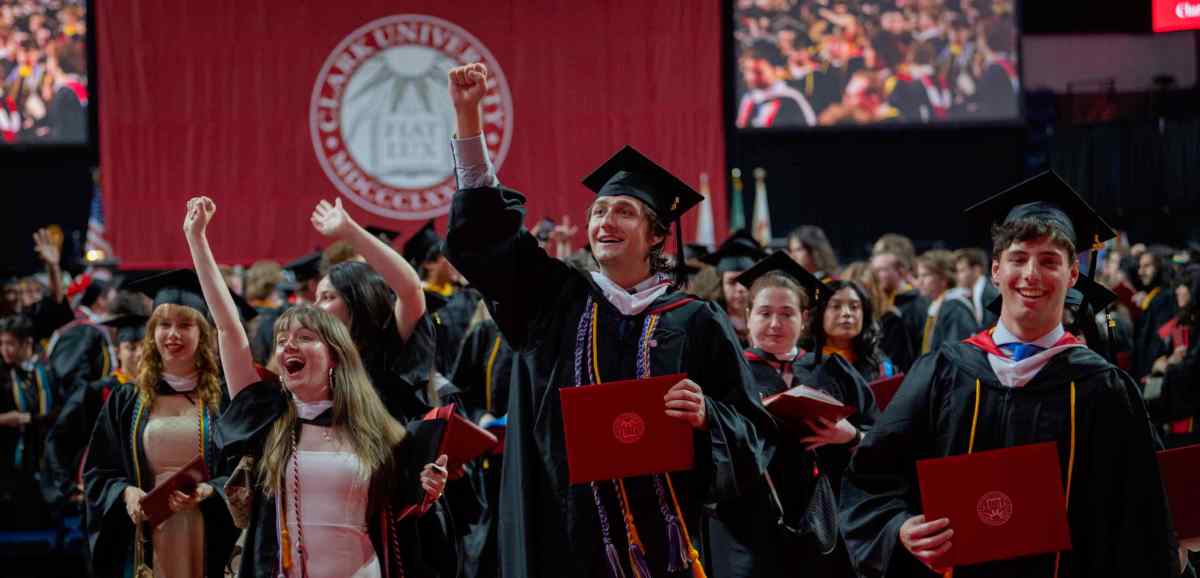
WORCESTER, MA — Kaya S. Banka, of Seymour, CT, received a degree during Clark University’s Commencement exercises on Monday, May 18. Banka graduated magna cum laude with a Bachelor of Science in Biochemistry and Molecular Biology. Banka is a member of the Fiat Lux honor society.
The University awarded 612 bachelor’s degrees and 636 graduate degrees and conferred two honorary degrees during two ceremonies; graduates represented 49 states and 69 countries.
Clark University President David B. Fithian urged the graduates to be engaged global citizens.
“The world needs you to exhibit the value of higher education, to exercise principles of free expression, to believe in the progress of ideas, and to defend democracy and individual rights – even, and especially, when doing so requires listening across deep differences,” President Fithian said.
Dr. Wendy L. Freedman, one of the world’s most accomplished astrophysicists, delivered the undergraduate ceremony address. Freedman, currently the John and Marion Sullivan University Professor of Astronomy and Astrophysics at the University of Chicago, is widely recognized for her leadership of the Hubble Space Telescope Key Project, which produced the first precise measurements of the Hubble constant (the rate at which the universe is expanding) and dramatically refined scientific understanding of the scale, age, and expansion of the universe.
Early in her career, Freedman told the graduates, her research arrived at a conclusion different than the accepted view of those in her field. She carried on despite opposition. Freedman noted that Clark physicist Robert H. Goddard, who 100 years ago launched the world’s first liquid fuel rocket, an advancement that helped pave the way for man to reach the moon, faced similar skepticism. After experiencing multiple failures and widespread derision, Goddard in 1926 launched his rocket, which traveled 2.5 minutes, rose 41 feet into the air, and landed in a cabbage patch.
“From a cabbage field to lunar and even farther missions,” said Freedman, “it is an important reminder of the power of persistence.”
Dr. Wendy Freedman was awarded the degree of Doctor of Science, honoris causa.
Student speaker William Stafford ’26, a political science major and aspiring lawyer, spoke to his peers about how choices shape a person.
“We don’t always get to choose our circumstances, but we always get to choose how we respond to them, and who we become because of them,” said Stafford. “And now we’re about to step into a world that won’t always give us clear directions. There won’t always be a syllabus. No one’s going to tell you exactly what to do next. But you will always have the ability to choose.”
Sir Andrew Steer, one of the world’s foremost climate experts, addressed Clark University students receiving master’s and doctoral degrees, and encouraged them to act boldly and remain hopeful, no matter their path.
In his address after receiving a Doctor of Humane Letters degree, Steer acknowledged that the students are graduating into a world with several major challenges – among them, AI, the erosion of trust in facts and truth, and dysfunctional governments. The last half-century has seen unimaginable progress and growth – demographically, technologically, and economically. “But this explosion of the human economic footprint has put unprecedented pressure on the planet and created severe inequality and social challenges.”
Steer praised Clark’s new School of Climate, Environment, and Society for including economics in its interdisciplinary lineup, which “is pointing precisely to the systems change we will need to address climate change.” And every single member of the Class of 2026 has a part to play, he said, whatever their field – education, finance, social work, healthcare, the arts.
Steer then turned his gaze fifty years into the future. “What will the world look like? My prediction is that it will be cleaner, greener, healthier, more prosperous, and more just. It’s up to you.”
Nourhan Beshir Attia, graduating with a master’s in environmental science and policy, delivered the graduate student address. A native of Egypt, she shared that the COVID-19 pandemic forced the cancellation of her bachelor’s degree ceremony in 2020.
“When I came to Clark, I thought I was looking for acceptance as someone coming from Egypt,” Beshir Attia said. “As a modest Muslim hijabi woman, I wondered: Will I belong here? And yes, I found people who respected me. But the most important thing I found was something I wasn’t expecting. I found the moment I stopped waiting for permission to be myself.”
Learn more and listen to “the sounds of Clark’s 2026 Commencement exercises” on our Challenge. Change podcast.
Founded in 1887, Clark University is a liberal arts-based research university that prepares its students to meet tomorrow’s most daunting challenges and embrace its greatest opportunities. Through 33 undergraduate majors, more than 30 advanced degree programs, and nationally recognized community partnerships, Clark fuses rigorous scholarship with authentic world and workplace experiences that empower our students to pursue lives and careers of meaning and consequence.