

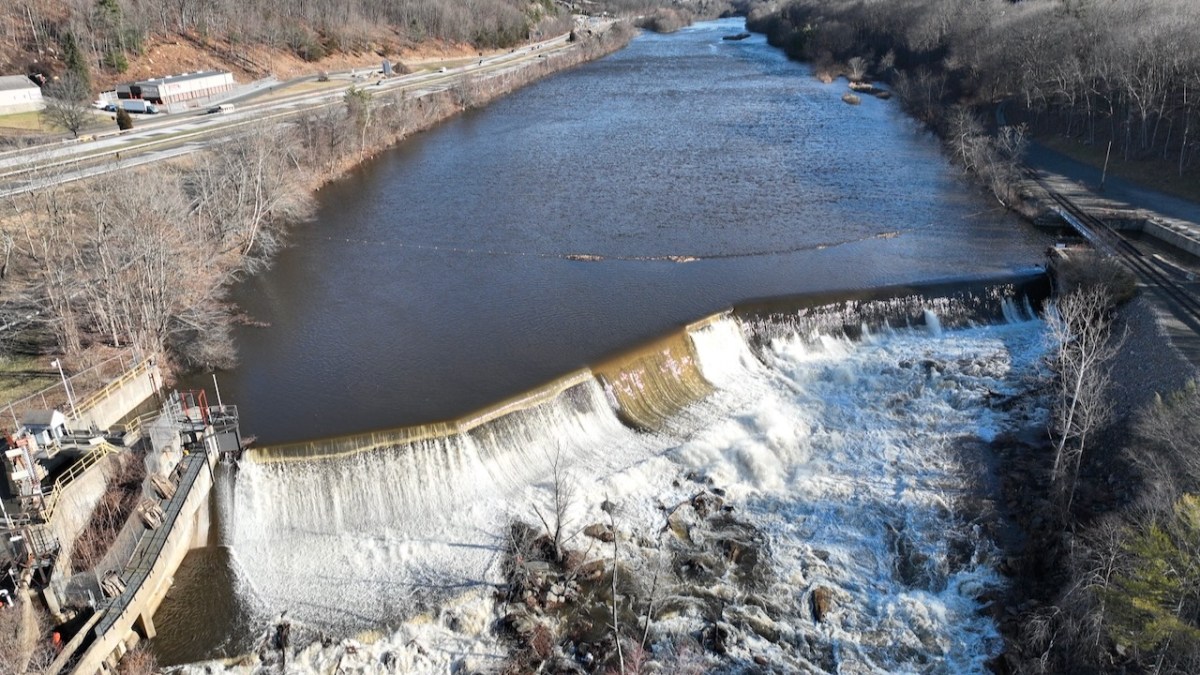
SEYMOUR – ANSONIA – The state Department of Economic and Community Development awarded $4 million to an agency working to demolish the defunct Kinneytown Dam near the border of Ansonia and Seymour.
According to a June 17 announcement from Governor Ned Lamont’s office, the state will give the money to the Connecticut Brownfield Land Bank, Inc., the nonprofit which took ownership of the dam last November.
The land bank is working with the Naugatuck Valley Council of Governments (NVCOG) and nonprofit Save the Sound to take down the dam. The dam blocks fish from accessing upstream habitats. It’s supposed to generate power but hasn’t worked in years.
The newest round of taxpayer money will go toward creating a model to remove contaminated sediments that have built up around the dam and building a system to sort those sediments.
“The $4 million should set it up, get it rolling, and put a process in place to hydraulically sluice the sediments from one place to another,” said Rick Dunne, who is both the executive director of NVCOG and president of the land bank.
He said there are about 300,000 cubic yards of material to be moved.
The money will help create “a model of where it needs to go – what can remain in the river, what can go downstream, what has to be removed to another place,” Dunne said.
NVCOG and Save the Sound are holding a virtual public meeting 6 p.m. Tuesday (June 23) to discuss the project and answer questions from the public. The meeting will be hosted via Zoom.
You can sign up for the meeting here.
Reaction
Elected officials applauded the latest round of funding on social media.
“This is exactly the kind of investment that improves our communities and our environment for generations to come,” said state Rep. Nicole Klarides-Ditria, who represents Seymour, Beacon Falls and part of Derby.
“This is an important step towards returning that area in Ansonia’s north end to safe use, restoring the watershed and public access to the area for recreation,” said state Rep. Kara Rochelle, whose district includes Ansonia and part of Derby.
Sewer Line Needs Replacement Before Sediments Get Removed
A previous step forward for the project happened last November, when the land bank purchased the dam facility for $1 after years of negotiations with the dam’s previous owner.
The land bank owning the land helps NVCOG and Save the Sound apply for grants, while also shielding Ansonia and Seymour from potential liabilities connected to the project.
The next step forward is to relocate two sewer siphons that need to be moved before any of the contaminated sediments can be touched.
Currently, the siphons cross under the river, carrying sewage from South Main Street in Seymour to the plant on the river’s west bank.
“Those two have to be replaced because they’re sitting in those sediments above the dam,” Dunne said.
The plan is to remove those siphons and replace them by extending the sewer line under the dam.
Dunne said that relocation will likely begin later this year and wrap up in early 2027. Then, the agencies will move forward with the sediment removal.
He said demolition of the dam could then begin in either 2027 or 2028, and the dam could be gone by 2029.
The demolition will also cause Coe Pond to go away, according to Dunne. Coe Pond is a human-made reservoir fed by a canal near the dam.
“Once you take the Kinneytown Dam down, the river level drops 28 feet. So once it drops 28 feet, the water will no longer flow in the canal that feeds Coe Pond,” Dunne said.
Dunne noted that the pond is also the site of some of the most contaminated materials surrounding the dam. He said the plan is to fill in the pond with about four feet of cleaner sediments to keep the contaminated materials buried.
Once the dam comes down, NVCOG officials have said greater riverfront access could be restored for pedestrians and businesses. It will also finally give function to a fish passage near the Tingue Dam upstream in Seymour. That passage was unveiled in 2014, but has largely proved ineffective because fish were being blocked by the Kinneytown Dam before they could even reach it.
Migratory fish, including shad and herring, will be able to swim upstream to Seymour and beyond once the dam is gone.
The Kinneytown Dam was built in 1844 to power Anson Phelps’ Copper & Brass Mill. It is some 30 feet high and spans over 400 feet across the Naugatuck River near the Seymour – Ansonia border.
Agencies Moving Ahead, Though Federal Funding Is Frozen
The demolition project has received about $63 million in total funding, Dunne said.
However, about $15 million of that funding comes from federal money awarded by the National Oceanic and Atmospheric Administration (NOAA) as part of the 2021 Infrastructure Investment and Jobs Act.
In January 2025, after President Donald Trump assumed office, he released an executive order instructing NOAA to stop releasing money allocated by that act.
Dunne said most of the project’s federal funding – about $10.3 million – has been affected by the funding freeze. That money has not yet been released.
However, Dunne said the freeze is not affecting current demolition plans. He said there is enough money from the state and other sources to continue work for now.
“We’re confident we’ll have money to finish the project when the time comes,” Dunne said.
He estimated the total cost of the project will be between $60 million and $70 million.