

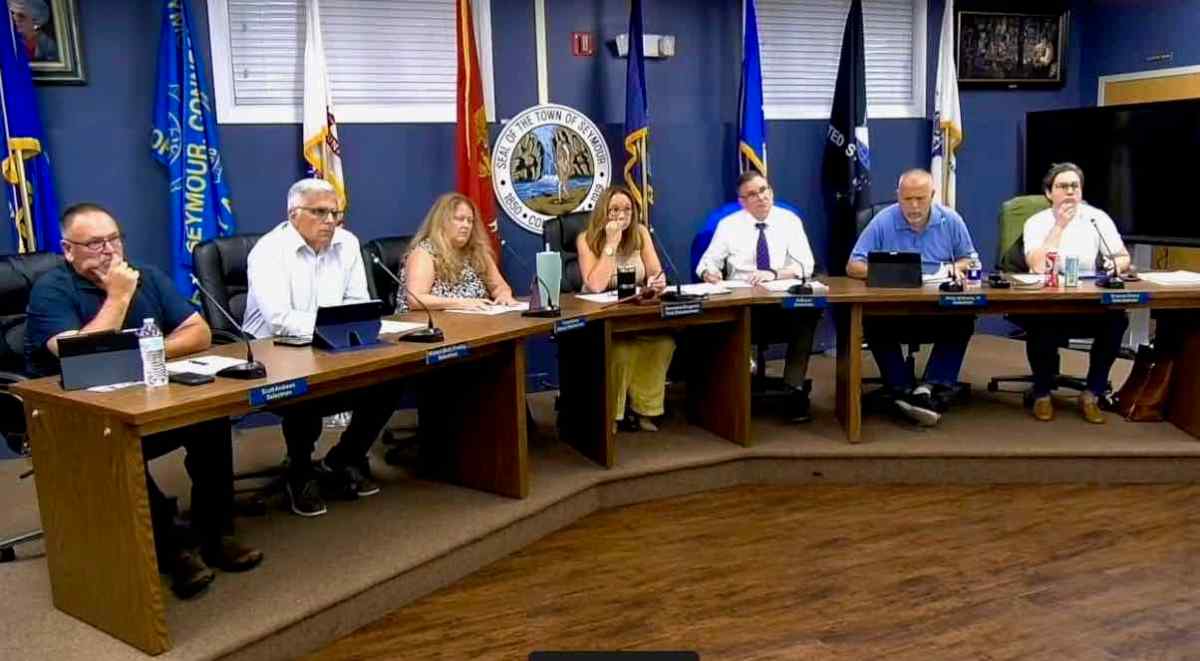
SEYMOUR – The Seymour Board of Selectpersons held their bi-monthly meeting Tuesday (Sept. 1). Here are some highlights.
Local Business Gets Tax Break
Microboard Processing, Inc., an electronics manufacturer located in the Silvermine Industrial Park since 1983 which produces advanced technology for aerospace, defense, medical and other industries, was granted a 72.5 percent tax break on new equipment over the next six years.
That translates to about $55,633 a year in savings for the company, according to First Selectwoman Annmarie Drugonis.
The Selectpersons unanimously approved the tax break that Microboard applied for following a $3.7 million investment the company made last year.
According to the application to enter the tax incentive program from Microboard officials, the investment represents one of the largest recent private sector manufacturing reinvestments in Seymour and reflects the company’s long-term commitment to maintaining and expanding its operations within the community.
Company officials said the $3.7 million investment includes $3.6 million in new manufacturing equipment, along with targeted improvements to the facility.
Renovations to repurpose 10,000-square-feet of manufacturing and engineering operations and the installation of a back-up humidity control system to support sensitive manufacturing processes, are included in the investment, according to the application from the company.
Cell Tower Report Now Expected In October
A consultant’s report about potential sites to build a cell tower on town-owned land – which was expected to be ready for the Selectperson’s meeting Tuesday (Sept. 1) – will have to wait another month.
The town’s finance director, Jason Vieira, said a consultant and town officials had a scheduling conflict and won’t be able to meet until Sept. 17 to view some potential sites in the town’s Great Hill area.
A report is now expected at the board’s meeting in October.
Vieira, at the selectperson’s meeting July 21, said the town is exploring options to build a cell tower that could potentially bring in between $200,000 and $250,000 in annual revenue.
Vieira said Verizon approached the town about wanting to build a new cell tower. He said the town could potentially benefit from building the tower itself.
“If the town builds it and the town pays for it, the town can choose what tenants they want on the tower, and collect the revenue from the rent,” Vieira said last month.
The town is working with Airosmith, LLC, a telecommunications company based in Sarasota Springs, NY, to develop a report.
Vieira estimated it could cost between $300,000 and $500,000 to build a cell tower, which the town would have to front. Vieira said the project would pay for itself in three or four years.
Vieira said Verizon is looking at three or four town-owned sites in the Great Hill area, which includes land at Gary Park off Davis Road.
Some New Ordinances On The Table
The Selectpersons are looking into creating some new ordinances. One is aimed at making sure residents don’t leave their trash cans on the curb for days on end. Another calls for creation of an agricultural committee.
Members voted to move the suggestions onto the selectperson’s ordinance committee for review. The next committee meeting is scheduled for 6 p.m. Sept. 15 at town hall. Any proposed new ordinances would need to be approved by the selectpersons, and public hearings would be required to allow residents to weigh in.
A draft of a refuse and recycling container ordinance was prompted by complaints from residents about public safety, particularly kids’ safety, with trash and recycling containers blocking sidewalks and curbs for extended periods of time, according to Drugonis.
“We’ve received complaints from businesses and residents about people leaving their cans out on the curb and it being a safety issue for kids, especially with school back in session,” Drugonis said.
A draft could require the removal of trash and recycling cans from streets, curbs, sidewalks and public rights-of-way within 24 hours after weekly collection. The 24-hour removal requirement would not apply during severe weather, holidays or emergencies. Violators would be given a written warning for a first violation, followed by a $25 fine for a second violation, and $50 for subsequent violations, according to the draft.
Several board members had mixed feelings about the matter.
“It feels very HOA (Homeowner’s Association) of us to be running around chasing after garbage cans,” said Selectperson Brianna Girard. “I understand the concern, but if I’m away for three days, I’m going to get a fine?”
“It’s kind of bordering on us becoming a policing town,” said Selectperson Trish Danka.
Selectperson Phil Wilhelmy said the matter deserves a deeper dive, especially because of the safety concerns.
“Children are walking to school and it’s an obstacle,” Wilhelmy said. “It’s going to take on a whole new look if it’s coming from a safety concern.”
Another ordinance would call for creation of an agricultural committee for the purpose of promoting, preserving, supporting and strengthening agriculture in town, according to Drugonis.
“We’ve been approached by a few people about forming a committee,” Drugonis said.
Such a committee could include seven appointed members, including farmers, whose responsibilities could include identifying and promoting the needs of Seymour farmers and agricultural businesses, recommending policies to support agriculture and identifying opportunities for farmland preservation and conservation, among other duties.
Right To Farm
Another ordinance the town is looking to adopt is the state’s “right to farm” statute. The statute was signed into law in 1981 by Gov. William O’Neill, and was designed, in part, to limit the circumstances under which agricultural or farming operations may be deemed a nuisance. Such nuisances are odors from livestock, manure, fertilizer or feed; noise from livestock or farm equipment; dust created during plowing or cultivation operations; chemical use, provided the chemicals and their method of application conform to practices approved by the state DEEP and/or state health department and water pollution from livestock or crop production activities, with the exception of pollution of public or private drinking water supplies.
Drugonis said Seymour never officially adopted the right to farm statute into the town’s ordinances. She said it’s important to do so as Seymour recognizes the importance of agriculture and farming operations in town.
Farming has been a hot topic in Seymour for a few months, following a complaint filed in April against Red Clover Farms from a neighbor alleging the farm has conducted activities not allowed in a residential zone. As a result, the town’s Planning and Zoning Commission is currently working on new regulations to add agritourism to its books.