

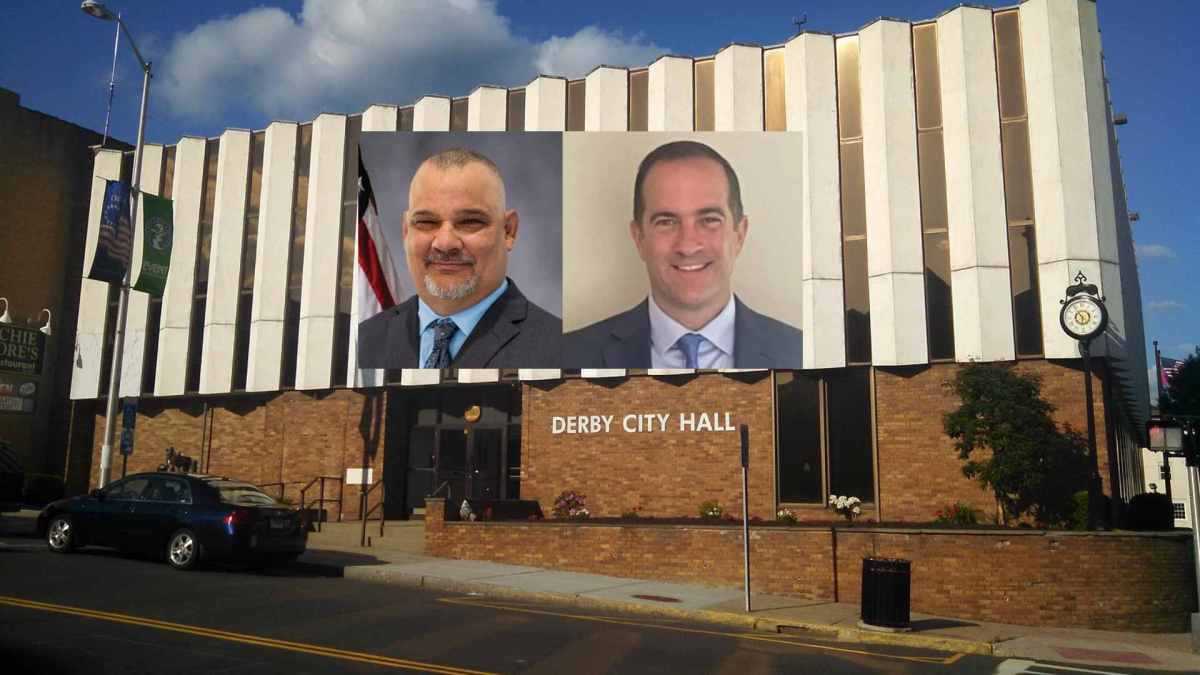
DERBY — Assuming an audit due at the end of the calendar year doesn’t have any surprises, the City of Derby may not have to appear in front of the Connecticut Municipal Finance Advisory Commission (MFAC) in 2027.
“Certainly things are in a very good place,” said MFAC Chairman Michael LeBlanc at his commission’s virtual meeting Wednesday (Sept. 23). “Unless the commission feels otherwise, I think we’re hopeful for the timely submission of your 2026 audit, and, with that submission, there would be consideration for Derby to be released from the commission.”
MFAC is an eight-member appointed panel of municipal finance experts who provide guidance to municipalities with budget issues.
“It’s a huge step forward,” Mayor Joseph DiMartino said after the meeting.
Background
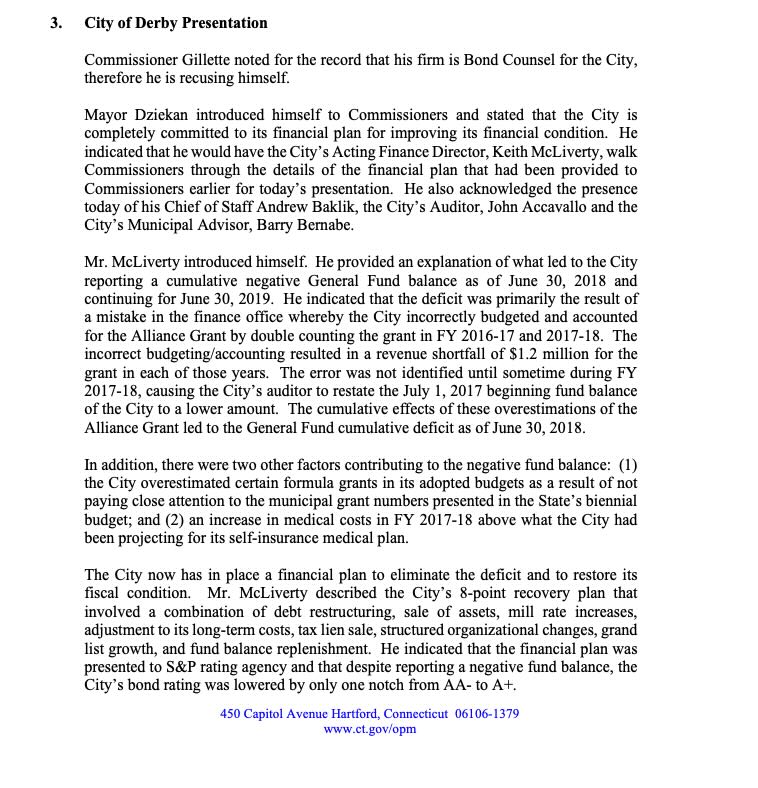
The City of Derby began appearing in front of MFAC in September 2020, after city officials discovered school district grant money had been counted twice by the finance office during budget cycles in 2016 and 2017.
That meant Derby was budgeting for grant revenue that was never going to arrive. The mistake led to a $2.4 million budget deficit, according to 2020 testimony from Keith McLiverty, who was serving as Derby acting finance director.
The city compounded the problem by overestimating state grants and underestimating how much it would spend on health care.
In response the city, under Mayor Rich Dziekan — who said the problems started prior to being elected — implemented an eight-point recovery plan.
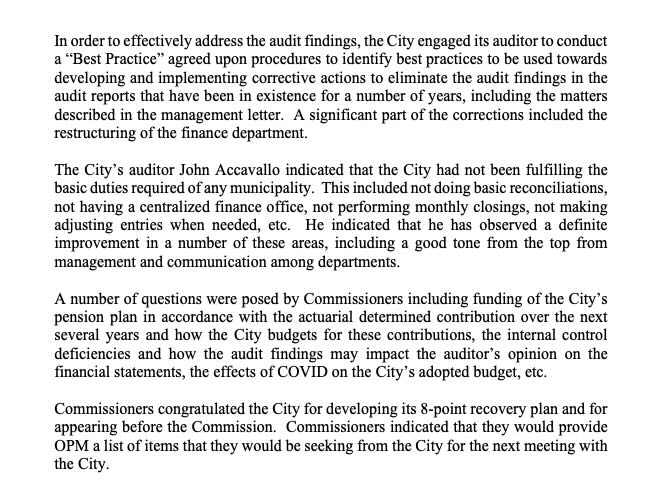
The two images embedded below are MFAC meeting minutes from 2020. The story continues below the images.
The MFAC appearances were voluntary until August 2023, when the commission voted to designate Derby a “tier 1” municipality. One member of the commission said she could not rely on the financial data that was being submitted by the city. The designation made the appearances mandatory, and required Derby to submit a five-year financial plan.
Watch the clip below from 2023. The story continues below.
As the MFAC appearances were happening, Derby saw a revolving door of finance directors, with MFAC members questioning why the position seemed to be tied to politics.
Mayor Joseph DiMartino was elected in November 2023. His administration hired Brian Hall as finance director.
Hall told MFAC previous Derby budgets were not based in reality, and that the city was draining its reserves to fund its operations. He said the city had been overestimating tax collection rates, and was still underestimating how much to spend on health insurance.
Hall said the city was facing another $2 million deficit. Another recovery plan was implemented. This one raised the mill rate by 4.6 mills, used federal COVID-19 money to bolster the budget, and temporarily decreased pension contributions.
Wednesday’s Meeting
The Derby portion of the Sept. 23 MFAC meeting was about three minutes.
Hall updated the commission on the status of an audit due by the end of the year, saying the city is on track to hit that deadline.
Hall also said he had been appointed the interim business manager at Derby Public Schools. Traditionally the city and the school district had separate head finance positions, but DiMartino’s administration launched a shared services committee that is looking to combine finance and human resources.
Derby had previously been unable to submit audits in a timely manner, sometimes missing the deadline by more than 200 days. The chronic lateness prompted a warning letter from MFAC.
If Derby hands in its 2026 audit by the end of the year, the city could be released from MFAC’s overwatch at the start of 2027, commissioners said at the meeting.
Reaction
While previous Derby administrations have released statements saying the city was on the right track financially, this is the second time in less than a year a third party has said positive things.
In April, S&P Global Ratings set Derby’s fiscal outlook to “stable.” It had previously been set to “negative.”
In an interview after the MFAC meeting, DiMartino, now in his second, two-year term, said getting the city on the right track financially was his top priority. A city can’t attract businesses and economic growth until it is on stable financial footing, he said.
“I was ecstatic when I got off that call,” DiMartino said about the meeting. “We are on solid financial ground. Our finance department, Brian Hall, the tax board, all the department heads, they all deserve a lot of credit.”