

ANSONIA — Members of the Board of Aldermen placed two deed restrictions on city-owned land Oct. 14.
The vote was 11-1-1 vote. Eleven Aldermen voted yes. Alderman Dan King voted no, and Alderman Steven Adamowski abstained.
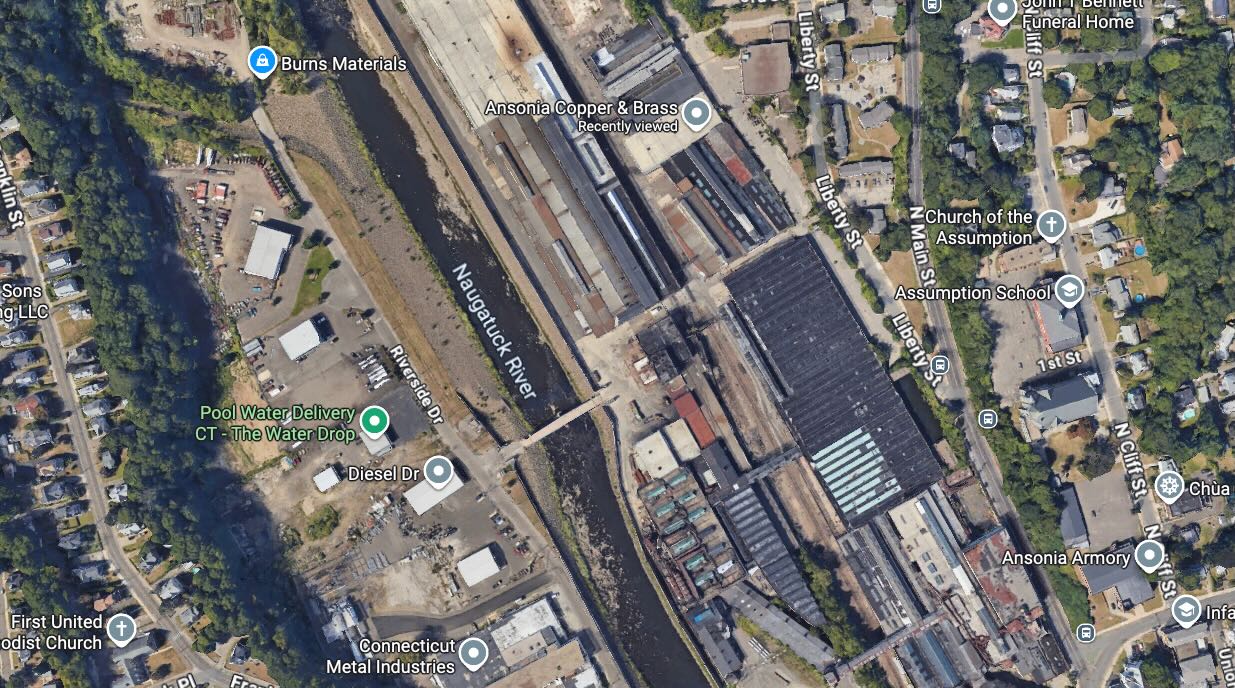
The move means there will almost certainly be neither a trash burning business nor high density housing on the former factory properties at 75 Liberty St., 7 Riverside Drive, and 35 N. Main St. The deed restriction includes a clause saying it can only be overturned by approval of two-thirds of voters at a referendum.
However, no developer or business actually proposed those uses at the properties.
CT Post Article
The Connecticut Post published a story Aug. 30 about the progress of the demolition at the former SHW property on 35 N. Main St.
The article reported incumbent Republican Mayor David Cassetti saying the city was entertaining many ideas from potential developers.
A “clean burn waste disposal plant and power facility” was a use mentioned by the mayor, according to the paper.
“Potential uses could be a clean burn waste disposal plant and power facility, and a ceramics manufacturer,” the Post reported.
The article continued:
“When it comes to the clean burn plant, Cassetti also said it would save the town millions in tipping fees for the disposal of waste and generate power for the city, which could also be sold to surrounding towns. He said that with clean and environmentally friendly technology, that the plant wouldn’t generate any pollutants for nearby residents.”
Reaction
Ansonia Democrats seized on the possibility of a “clean burn plant,” saying it would be terrible for the city.
Frank Tyszka, the Democrat challenging Cassetti for mayor, held a press conference Sept. 25 lambasting Cassetti. He held the conference near the former Ansonia Copper & Brass site at 75 Liberty St.
“What we absolutely don’t need is a toxic waste-to-energy plant located in a neighborhood that contains churches, daycare centers, and a school, all within yards of each other, in a city that has both a limited area and a high-density population,” Tyszka said.
Although Cassetti’s initial comments concerned a different property, both candidates have referred to the Ansonia Copper & Brass sites (75 Liberty St., 7 Riverside Drive) and SHW property (35 N. Main St.) interchangeably.
The Ansonia Town Democratic Committee also went after the mayor on social media over the subject.
Cassetti responded using the city’s Code Red robocall system, saying there were no plans for a trash burning facility in Ansonia.
“My words in a recent article were misunderstood — I was simply repeating ideas I’ve heard over the years,” Cassetti said in the recorded message.
Post, Part II
The Connecticut Post published a story Sept. 30, again reporting on the future of the North Main Street property.
In that story, Cassetti said no trash-burning business would be happening in downtown Ansonia, and that he would ask the Aldermen to place deed restrictions on the property to restrict the use.
Cassetti said he would also ask the Aldermen to ban high density housing on the property.
However, the article reported Tyszka suggested affordable housing as a possibility.
From the story:
While Cassetti seems poised to ban housing development from the parcel, should his deed restriction pass the Board of Alderman next month, Tyszka also said that he was looking at affordable housing opportunities, saying that the city was in need of more dense housing for working families. While Ansonia has 14.8% affordable housing, according to numbers reported by the state in 2024, above the required 10% expected by the state, Tyszka said there remained a high demand.
“I’m going to look at the big picture. I’m already looking at affordable housing. Not low income housing, not Title IX housing, but housing. Because we need housing in Ansonia,” he said, stating he also wanted to create a small grocery store, so people could have access to food downtown.
The current city administration doesn’t have an interest in new housing, wishing to instead solely focus on manufacturing potential to bring in more revenue.
Reaction
This time Cassetti held a press conference to react to Tyszka’s comments. It was held Oct. and focused on “Team Cassetti’s” opposition to “high density housing” off North Main Street (and the other former factories).
“(Tyszka) believes we can cram more dense housing into Ansonia,” Cassetti said. “He believes our taxpayers, our students, and our families should carry the burden for the rest of the state.” Cassetti said the future of the Copper & Brass site and the SHW properties should include manufacturing and business – but not more housing.
The Ansonia Republican Town Committee went after Tyszka on social media.
Tyska said he was using the dictionary definition of “affordable housing,” not the government’s statutory definition.
Ansonia officials have repeatedly pointed out that the city meets the state’s requirements for affordable housing while wealthier communities do not.
“(Republicans) are putting words in my mouth,” Tyszka said. “My model for mixed-use in housing is Quarry Walk in Oxford. It’s certainly a better use than a dangerous waste-to-energy plant to favor developers.”
Just prior to the Aldermen’s Oct. 14 vote to ban housing and a trash facility at the properties, Cassetti invoked the 2002 murder of 16-year-old Damontis Johnson, an Ansonia High School student athlete gunned down at the former Riverside Apartments, a federally subsidized housing complex that was torn down thanks to the efforts of Cassetti and his predecessor, James Della Volpe, a Democrat.
Cassetti called the murder the product of a “failed social experiment of high density housing that had turned from affordable homes into isolated blocks of despair.”
“We promised ourselves then, never again, and yet here we are, decades later, hearing whispers once again that Ansonia would welcome high-density housing back into our city,” Cassetti said during the meeting.
Is High Density Housing Low-Income Housing?
High density housing and the government’s definition of affordable housing are not synonyms. High-density housing already exists on Ansonia’s Main Street in the form of apartments, both built and proposed.
Cassetti told The Valley Indy at his press conference high density housing works on Main Street, but that the future of the former factory properties must be used to expand the city’s tax base: commercial and industrial uses.
The former Riverside Apartments on Olson Drive referenced by Cassetti in his statement, meanwhile, were owned by the federal government, under the jurisdiction of the federal department of Housing and Urban Development.
Crime was a major problem there. Veteran police officers told The Valley Indy the property became an open-air drug market in the 1990s.
In 2000, the Olson Drive complex logged almost half of the city’s arrests for serious crimes like murder, assault, drug crime, robbery, rape and weapons violations. The crime rate dropped significantly by 2010, but there was still violence happening.
The Della Volpe administration started the push to get rid of the complex, which had become run-down and plagued with maintenance issues. The Cassetti administration continued the effort, and managed to secure a deal once thought impossible that saw the Ansonia Housing Authority work to spread low-income units throughout the city – a modern approach to housing – instead of in a single, large cluster.
The Cassetti administration then purchased the land from the Ansonia Housing Authority, and sold it to a private developer, who has plans to build a private athletic complex there, though that project has been substantially delayed.
The Oct. 14 Alderman Vote
Prior to formally casting votes, members of the Ansonia Board of Aldermen discussed the two deed restrictions.
Alderman Adamowski said the city’s plan of conservation and development calls for a mixed use on the properties. Housing, with other land uses, is mentioned on pages 10 and 11 of the document, which can be viewed here.
“The historically industrial areas east and west adjacent to the Naugatuck River are envisioned to be redeveloped as mixed-use commercial with more dense residential development to support the commercial development,” the plan says.
Adamowski said some housing could work to a small extent on Liberty Street, where a former Ansonia Copper & Brass building is already surrounded by residences, including the Liberty Pines condominiums, which classifies as high density housing.
Adamowksi said the city has an obligation to get something that fits with the neighborhood. He also said the removal of an outdated, blighted pump house in the area will allow access to the Naugatuck River.
However, Sheila O’Malley, the city’s former economic development director who still consults with the City of Ansonia, said the Liberty Street property is zoned “heavy industrial.”
Adamowski requested to add his suggestion as an amendment to the deed restrictions. The amendment failed by an 11-2 vote. Adamowski and Alderman Dan King were the two yes votes.
Election Day is Nov. 4.