

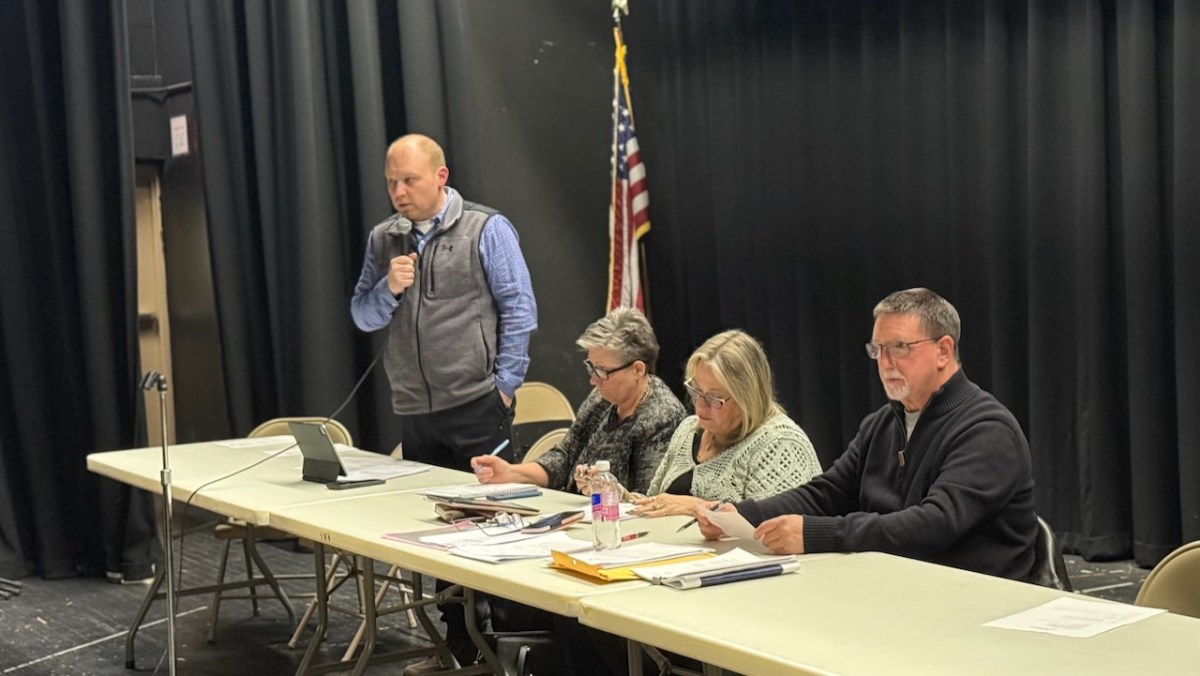
ANSONIA – The city’s planning and zoning commission Monday (March 2) unanimously rejected an application to convert a former nursing home on Ford Street into 91 studio apartments.
New Haven developer Adam Haston wanted to convert the 47,187-square foot former Hilltop Health Center nursing home at 126 Ford St. into age-restricted studio apartments. The building has been vacant since the nursing home closed in 2013.
Neighbors opposed the idea, saying it would generate too much traffic. They spoke out against the application at public hearings.
Resident Evelyn Kish said she was happy with the commission’s decision. She said the 91 units in the proposal were too many.
“I’m delighted that the board has taken into consideration all that the public has said to them,” she said. “We are open to something, but this particular project was too big. It was just too dense.”
During the meeting, commissioner Maureen McCormack said she did not believe a traffic report from the developer’s consultant.
“Although they had a traffic specialist saying that there really wouldn’t be much additional traffic congestion, that doesn’t seem logical as a result or to any of the members of the public, if we’re adding so many people,” McCormack said.
She also cited concerns over the living space of the units. Plans shown in previous meetings included about 350 square feet per apartment.
Dominick Thomas, the attorney representing the developer, told The Valley Indy an appeal of the decision to Superior Court is possible.
Haston doesn’t own the land, which isn’t unusual in development proposals. Often a developer will work out a purchase that is contingent on an approval from the planning and zoning commission.
“I’ll have to have a discussion with my client, and I’ll have to have a discussion with the owner’s attorney, and we’ll see where we go from there. There is the possibility of an appeal,” Thomas said.
Thomas said he was frustrated that the findings of his client’s traffic engineer were ignored. He said the commission didn’t consult city planner David Elder before voting.
“That’s why developers hire traffic engineers, because they are experts in the area. With all due respect, neighbors aren’t experts about traffic,” Thomas said.
Thomas said it didn’t make sense to pass up the proposal, which he estimated would bring in between $130,000 and $180,000 in annual tax revenue, at a time when the city is struggling to find enough revenue to make its budgets work.
Across two public hearings held Dec. 8 and Feb. 9, about 20 hilltop residents said the proposal would have disrupted life in the neighborhood. Many of those residents said they wanted to see the vacant property be redeveloped – but also said 91 apartments were far too many for a neighborhood mostly consisting of single-family homes.
Resident Ernie Marino submitted a petition in February, signed by 37 neighbors, which urged the commission to reject the application.
Residents cited concerns over traffic and the impact on home values in their opposition.
Neighbors, including Stan Kapinos, said they were “burned” by the previous nursing home operator, who promised a state-of-the-art facility, but that facility then deteriorated over the years before it closed. Kapinos said in December that he was worried Haston’s proposal would turn out the same way.
There was little discussion on the proposal before the vote. All commissioners voted against it, with the exception of Dana Haigh and William Malerba, who were absent.
Haston previously converted a 29-unit apartment complex on Springside Avenue in New Haven to 42 apartments, according to tax assessor records. He also led the conversion of a former Meriden hotel into 165 apartments in 2021.
The property at 126 Ford St. has been owned by TCHI Company LLC, formerly known as Meditrust of Connecticut, since 1992.