

SEYMOUR – A twice-denied zone change to switch three single-family, residentially zoned properties on Pearl Street to multi-family is in front of the Seymour Planning and Zoning Commission again.
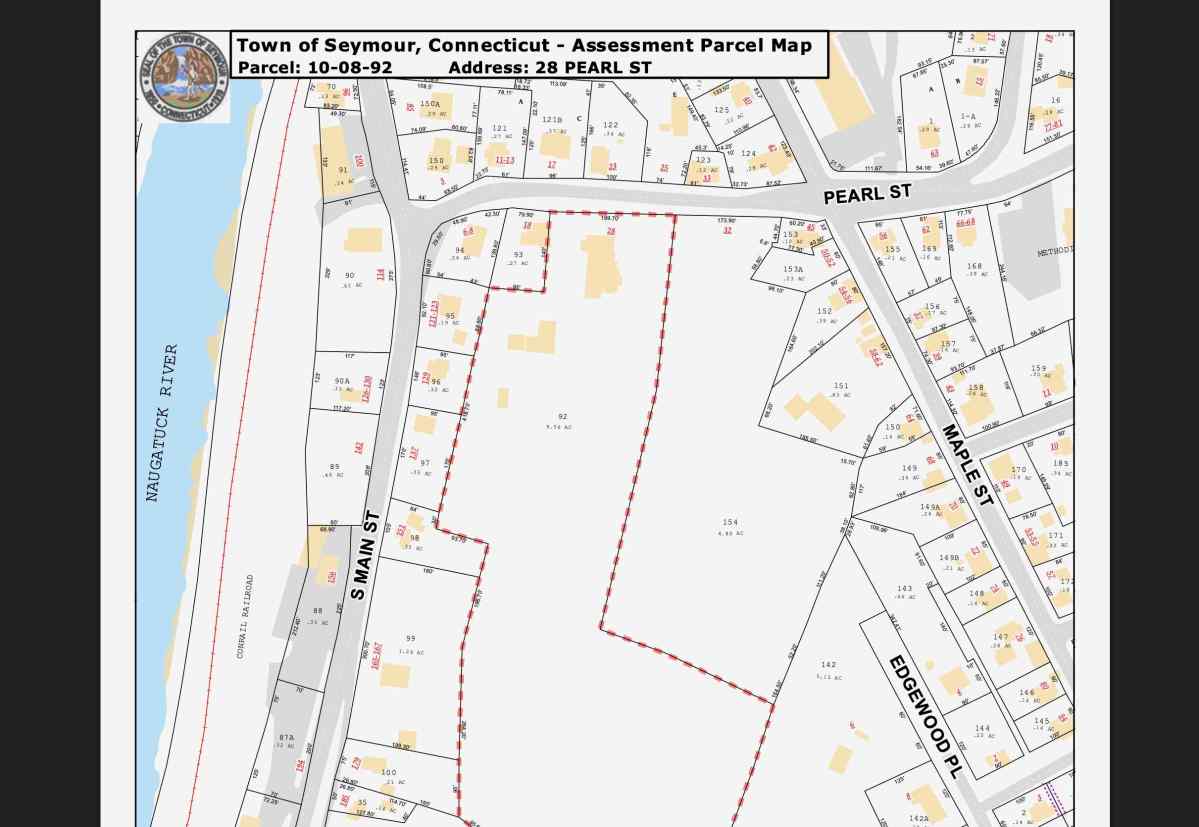
Second Street Construction, LLC, based in Oxford, is requesting the zone change for its properties at 18, 28 and 32 Pearl St.
This is the same request the developer made in 2024, which was ultimately rejected by the commission. The commission denied the same request in 2023.
The commission, at its monthly meeting April 9, scheduled a public hearing for 6 p.m. May 14 at the Seymour Community Center, 20 Pine St., on the latest proposal.
None of the commission members commented on the zone change request during the April 9 meeting. The developer was not in attendance.
The properties total about 14 acres.
According to town land records, 28 Pearl St. is the Roberta King Estate, a circa-1900 brick mansion previously owned by the late Roberta King, a former Seymour Selectwoman and philanthropist. The property at 18 Pearl St. houses a Cape-style home built in 1745. The property at 32 Pearl St. is vacant land.
Second Street Construction purchased the three properties for $1.3 million in 2018, according to town land records. The properties are surrounded by a mix of single-family and multi-family homes, along with a nearby deli, a Thai restaurant, a barber shop, and apartments at the former LoPresti School site.
The commission denied a previous request to change the zoning to multi-family in August 2023 by a 2-1 vote. They cited concerns about traffic and property values.
The commission voted 3-2 in favor of the zone change in April 2024. However, a verified “protest petition” had been filed with the commission, which triggered a rule in Seymour land use rules that required a two-thirds vote for it to pass. It needed one additional “yes” vote to pass.
According to Dominick Thomas, the lawyer for the developer, a new state housing law changed the rules regarding “protest petitions.” A simple majority is now needed.
Click here to learn more about what previously qualified as a “protest petition” and what the rules are now.
Thomas said if the zone change is approved, his client would apply to build development of 108 housing units in three buildings.
A site plan application has not yet been submitted to the commission. The developer needs the commission to grant a zone change in order to make the site application possible.
Thomas said the developer has the option of using state law 8-30g, a controversial measure that allows – under specific circumstances – developers to supersede local land use boards if a percentage of units are affordable.
“Regardless, 8-30g remains an option, but my client, as most developers, prefers to work with the community,” Thomas said.
Neighbors have previously turned out to oppose the zone change, saying the neighborhood already has high density housing.
Many neighbors cited concerns of increased traffic congestion and said the zone change would result in a housing development too large for an already densely populated area.
Thomas said the zone change is a good economic development project that shouldn’t be shot down by “NIMBYism” (a term which stands for ‘not in my back yard’) .
“All that does is result in higher taxes and no economic development because businesses need housing in their communities,” Thomas said. “Most importantly this development would substantially increase the amount of real estate taxes paid on the property.”