

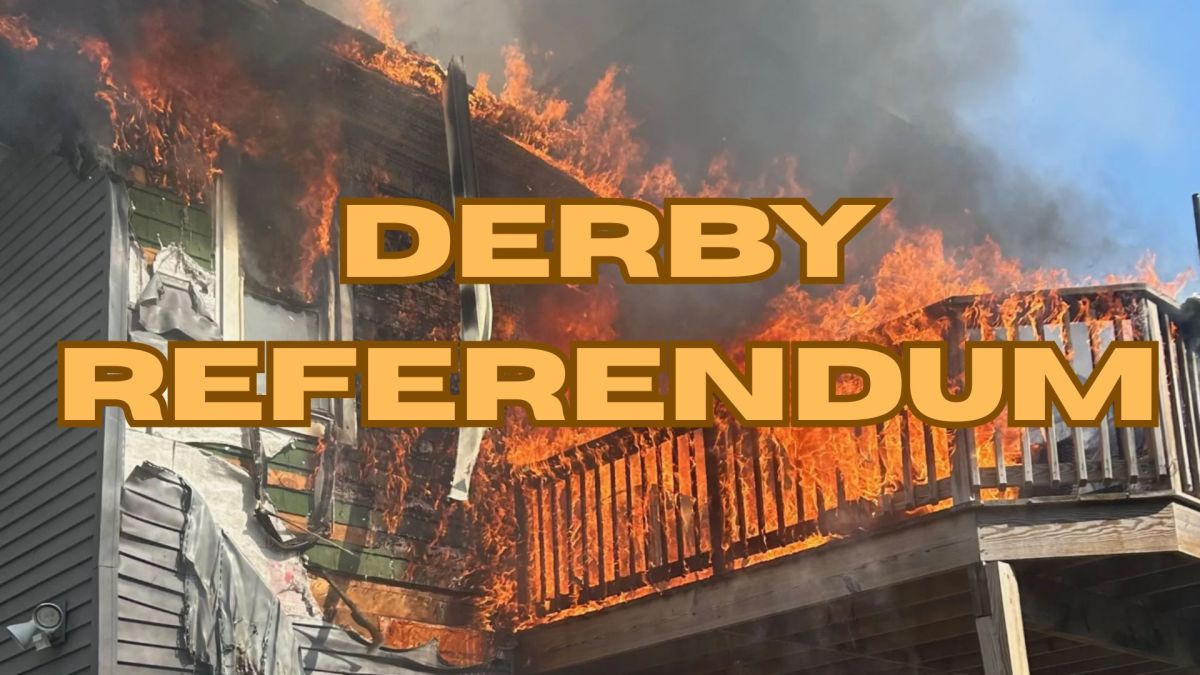
DERBY – Voters in Derby are being asked to approve $6.5 million in borrowing for capital improvement projects. About 77 percent of the money is related to replacing old emergency service apparatus.
Here is the list scheduled to go to voters on Election Day (Nov. 4, 2025).
- $3 million for two Derby Fire Department pumper trucks
- $1.5 million for a rescue truck for the Storm Engine Co.
- $560,000 for two Department of Public Works trucks
- $550,000 to replace the public safety radio system
- $400,000 to replace the HVAC system at Derby Public Library
- $358,000 to replace the chiller at Derby Middle School
- $132,000 as contingency
The Valley Indy conducted a livestream interview Sept. 15 with Derby Fire Commissioner Gary Parker, Derby Fire Chief Thomas Biggs, and Storm Ambulance & Rescue Chief Thomas Lenart Sr. to talk about the purchases connected to Derby emergency services.
What follows is an edited summary of the conversation. The complete video is posted at the bottom of this story.
Valley Independent Sentinel:
Chief Lenart, why is a new rescue truck needed?
Lenart:
The age of the vehicle itself. It was built in 1994, so we’re coming up on 31 years. It goes out on about 600 calls a year. The calls it goes on vary greatly: motor vehicle accidents, all types of rescues, trench rescues, confined spaces. It also does medical calls. With more folks moving into town, and even into Shelton, our ambulances are getting busier and busier.
While the ambulances are busy, we’re utilizing the rescue truck on first-responder medical calls.
We’re looking to replace an aging piece of equipment. Last year, about $40,000 of maintenance went into that truck. It’s seen its day. It has served us well. I haven’t seen apparatus last that long as in first-line (responses). (When something) like that gets that old, it becomes secondary, a second-line apparatus as backup. We’re still running this thing as first line, ready to go.
It needs to go. It needs to be replaced.
If you’re looking at how long this thing has lasted, I think we paid $259,000 for it back in 1994. If you average that over 30 years, I think the taxpayers got their money’s worth out of it.
Valley Independent Sentinel:
You mentioned maintenance. How often does the rescue truck need repairs? If voters say no to this, what do you do then?
Lenart:
I don’t really have an answer to that (referring to voters rejecting the borrowing).
We lost the rescue truck before this to an accident. We borrowed a sea green yellow van from the Milford Fire Department and put what we could on it.
I don’t know if there is a solid fallback position right now.
What are we doing for maintenance? We’re trying to stay on top of it. It’s like every time a scratch or cut shows up we’re putting a Band-Aid on it and hoping it doesn’t fall off. Now it’s coming to the point we’re trying to find parts. It’s impossible. Jim Saldamarco (longtime member) was on Ebay scouring for parts not too long ago. We’re at that stage.
Valley Independent Sentinel:
Switching gears to the request from the Derby Fire Department for two pumper trucks, first explain what a pumper truck is.
Biggs:
A pumper truck, we call it an engine. It supplies the water and the hose to put out a fire. It has other uses, too, like in a car accident. It does blocking, it carries Speedy Dry and personnel to all different types of calls, but its main focus is to put out fires.
Valley Independent Sentinel:
Which is important, I assume, Commissioner Parker?
Parker:
It’s very important for the citizens in many ways, including property insurance. There is an organization called the ISO, Insurance Services Organization. They rate fire departments all across the United States. The better the rating there, it has a positive effect on property insurance rates.
Valley Independent Sentinel:
How old are these two pumper trucks that need to be replaced, and what type of condition are they in?
Parker:
We started this process in 2019. We had five engines, or pumper trucks, and one ladder truck. Around 2022, one truck was a 1992 Pierce, we took that one out of service, because, as Tom said, they get to a point where you just can’t get parts for them. It wasn’t fiscally prudent to keep that one going.
So we have four left, two on each side of town. The two we are replacing, one was built in 1996 and (one was built in) 1999.
Valley Independent Sentinel:
Are the maintenance costs going up each year?
Parker:
Our maintenance budget has gone from about $50,000 in 2021 to last year, $130,000. We’re over $100,000 (each year) for the last three years. It’s a lot of money. Like Tom said, we don’t wait to fix things anymore. There was a time when there would be a loose door or something like that and we may let that go. We don’t do that anymore. We fix everything we see, because we don’t know when we’ll get new ones.
Valley Independent Sentinel:
Chief Biggs, how often are you dealing with problematic trucks?
Biggs:
It’s huge. Right now at the Storms they’re having a problem with building air and keeping air in their trucks, so they are on a delayed response because they can’t get the trucks out right away. It takes time to build air back up so they can physically move the trucks.
Engine 13 was out of service for a month. (Engine) 14 has been out of service since the middle of August (it’s a 2009 vehicle that is getting its engine replaced). We’re not sure when that’s coming back.
They are all old trucks. Anything can break down at any point in time. You just don’t know. It’s always weighing on my mind.
Valley Independent Sentinel:
Derby has had financial issues for the better part of a decade. The city makes regular appearances in front of the state’s Municipal Finance Advisory Commission. There was a large mill rate increase to close budget holes in the spring of 2024. What about people out there who say ‘we just can’t take it anymore?’
Parker:
The city has bond debt currently. Some of it is old. They borrow money and they pay it off over a period of time. As (old debt) comes off, that opens up a capacity to borrow more money. That’s why we are going now. We’re going with a $6.5 million bond issue because that’s what (Derby Finance Director) Brian (Hall) determined the city is capable of borrowing without a huge strain on the tax rate.
(Note: click here for a separate story on how Derby plans to manage the borrowing if approved by voters Nov. 4.)
Valley Independent Sentinel:
What if we wait to make these purchases?
Lenart:
The first thing I’ll say is that if we wait a couple of years the prices are not going to be any less than they are now. They are probably going to go up even higher. I don’t remember what the first estimates were in 2018 for the rescue truck . . .
Biggs:
I think they were just under ($1 million).
Lenart:
. . . the prices skyrocketed, and they are not going to go down. The other thing we have to think about is delivery time. We are not going to see these trucks for two years, maybe three.
Parker:
That’s right.
Lenart:
And that’s when we are going to start paying for them. Yes, we are going to authorize the bonding and the money, but we are not going to have to start making payments until we get the trucks.
Over in Shelton, they are getting two pumpers in December. They were ordered three years ago.
Parker:
If I can, may I bring up the radio system?
Valley Independent Sentinel:
Yes, go ahead (note: the Nov. 4 vote is also asking voters to approve $550,000 for a new emergency radio system).
Parker:
The emergency radio system . . . our two-way radio system. The basis of it, the main base station, is still analog. It’s obsolete to the point where in a heavy — or maybe not even in a heavy – rain storm, it sounds like there is a frying pan coming out of the radio. The rain on the wires makes it crinkle.
It’s obsolete. It needs to be updated. That is $550,000. We have to replace (equipment) at several locations. It’s a complicated system, and it will all be replaced with fiber optic connections. It is well past its due date.
Valley Independent Sentinel:
Chief Biggs, what’s it like to deal with the radio system in its current state?
Biggs:
It’s one of those things we never know if it is going to fail or not. I got a phone call from our dispatch probably three or four months ago at 6:15 in the morning saying your radio system in dead. We had no radio system. Thankfully the guy who takes care of our radio system for the department was able to fix it very quickly, but we could be operating at an incident and it just stops working, and we wouldn’t be able to hear if someone needs help. It weighs on my mind greatly.
Note: to watch the complete interview with Biggs, Lenart and Parker, please click the play button on the YouTube video below.