

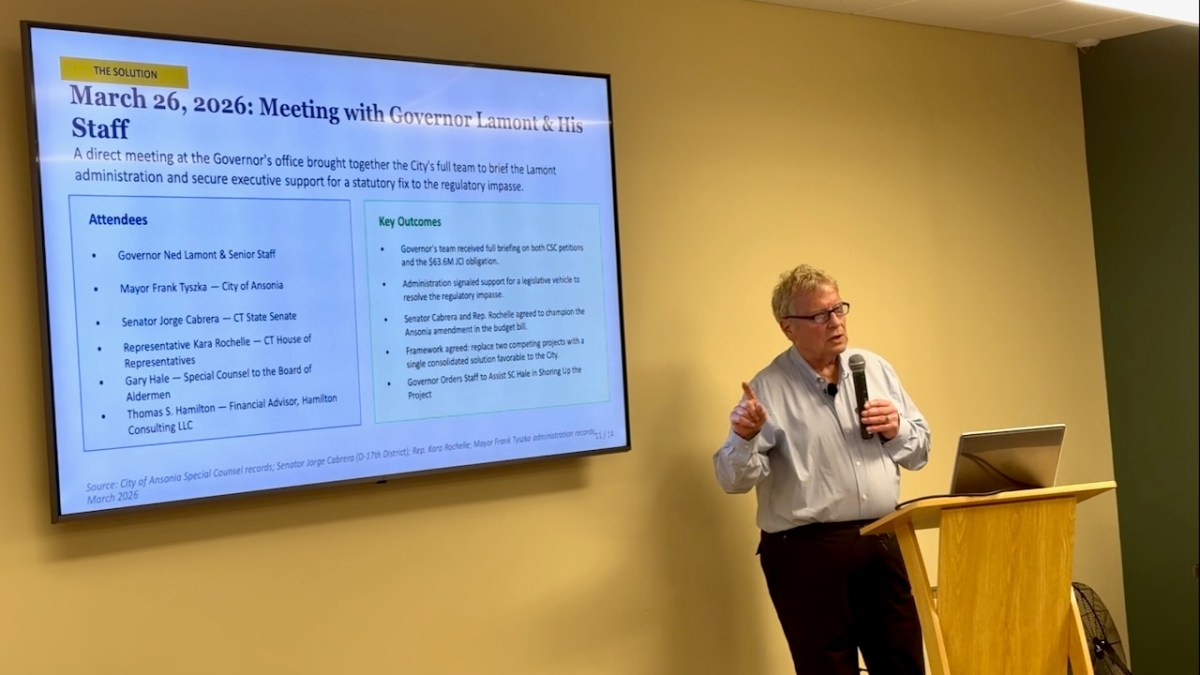
ANSONIA – This week former state Sen. Gary Hale outlined Mayor Frank Tyszka’s administration’s next steps to install fuel cells on a former industrial site, after a deal stalled and state legislators stepped in to assist.
At a presentation held at the Ansonia Senior Center June 9 during the Ansonia Board of Aldermen meeting, Hale said the city has the ability under a new state law to put two fuel cell facilities on 35 N. Main St., the former SHW site.
The city, under former Mayor David Cassetti’s administration, had previously found itself in a gridlock after entering talks with two separate companies, HyAxiom and Johnson Controls International, about installing fuel cells.
State regulations prohibited both companies from operating at the same site. Neither project was moving forward.
However, Hale said a new state law carves out an exception where state regulators could take a second look at the proposed projects and potentially approve them both.
The state law “consolidates the two projects, so instead of now having one fuel cell project that was gridlocked, we unlocked the gridlock. Now there’s going to be two fuel cell projects that produce revenue for the people of Ansonia when they’re built,” Hale said.
Hale, who served in the state Senate representing Ansonia from 1987 to 1993, is now a consultant for Tyszka’s administration.
Earlier this week the mayor wouldn’t say how much Hale is getting paid. Hale called The Valley Indy and explained that he’s being paid between $42,000 and $45,000 by the city’s law firm. The money originates from the city’s legal expense budget.
Background
Taxpayers are on the hook to pay Johnson Controls $63.6 million by 2045 for a fuel cell deal inked in 2024 under former Mayor David Cassetti’s administration.
Those payments were supposed to be covered by revenue generated by the fuel cells.
However, those fuel cells were never installed because the deal fell apart.
The problem was that Cassetti’s administration had previously talked with another company, HyAxiom, about installing fuel cells on the same site. HyAxiom went to the state Siting Council in 2024 and received approvals for the project.
In 2025, state regulators on that council blocked Johnson Controls from moving forward, even though the Cassetti administration wanted to hire the company. The Siting Council said they had already given HyAxiom approvals.
The project stalled.
“No competing project was ever going to break ground at this thing. That’s why it was gridlocked, because the city left HyAxiom at the altar and went with somebody else. However, they signed an agreement with Johnson Controls and paid them the money,” Hale said at the presentation.
The city was still on the hook for payments to Johnson Controls, even though the deal was blocked.
New Legislation Sets ‘Path Forward’
The Aldermen authorized Tyszka to retain Hale as special counsel in February to find a way past the gridlock. Hale is a former co-chair of the state Senate Committee on Energy & Public Utilities and has done lobbying work for renewable energy companies since leaving elected office.
Hale said he met with state elected officials, including Gov. Ned Lamont, state Rep. Kara Rochelle, and state Sen. Jorge Cabrera in a series of about 40 meetings throughout the legislative session to figure out a way forward.
Also present in various meetings were officials from regulatory bodies including the Siting Council and the Public Utilities Regulatory Authority (PURA), Hale said.
The result was language in Senate Bill 477, which created a series of provisions designed to allow HyAxiom and Johnson Controls’ projects to move forward in Ansonia.
The language was hard to decipher, a point of criticism from state Republican legislators, according to reporting from the Connecticut Post.
According to Hale’s June 9 presentation, the bill does a few things:
- It allows the Siting Council to reopen the previously denied petition from Johnson Controls International. It also allows the council to greenlight two fuel cell projects on 35 N. Main St. instead of one.
- It also allows PURA to take another look at Johnson Controls’ project. PURA is required to “consider the financial condition of the municipality” in deciding whether to approve or deny the project.
- It qualifies the fuel cell projects for a “distributed generation rebate rider,” a state energy credit which Hale said will make them financially viable.
- It allows the Connecticut Green Bank to purchase power generated by the fuel cells to power state facilities – for example, streetlights. Hale said the project previously lacked a buyer, another factor which had made it financially unviable.
Hale said renegotiating the city’s $63.6 debt obligation with Johnson Controls is the next step, beginning with a meeting scheduled June 10.
The state law does not automatically grant approval to Johnson Controls’ project. However, it allows state regulators a way to greenlight the project, whereas previously they had no way to do that.
Fuel Cell Payments Not In City Budgets
Tyszka has described the fuel cell payments as a major issue affecting his administration’s budget-making process this year.
He said when he stepped into office Dec. 1, he was greeted with a “surprise” bill for $695,551. It was a payment due to Johnson Controls for the fuel cells.
Officials in Cassetti’s administration had not included about $1.56 million in payments due to Johnson Controls in this year’s budget.
In addition, finance officials booked about $1.26 million in fuel cell revenue, even though nothing was built.
Together, those decisions created a budget shortfall of about $2.82 million.
The city’s new budget, which was adopted by the Aldermen June 9 after Hale’s presentation and kicks into effect July 1, also does not include about $3 million in fuel cell payments.
Tyszka said in April the omission is because of private talks between city officials and Johnson Controls which could lead to a revision of the debt payments.
The Valley Indy requested the city’s budget on June 9 and June 10. A reporter received the budget around 4 p.m. June 10, a day after it was passed into law.
Hale, Tyszka Want City Out Of Energy Business
The deals from HyAxiom and Johnson Controls are structured in two different ways.
Under HyAxiom’s deal, HyAxiom will install their own fuel cells and operate them. The city will make money by charging lease payments to HyAxiom.
Under the Johnson Controls deal, Johnson Controls will install fuel cells manufactured by Bloom Energy, based in San Jose, Calif. Then, the city will operate the fuel cells, making money by selling the power from the project. The city’s debt to Johnson Controls is the cost of having the fuel cells manufactured and installed, plus interest.
Hale and Tyszka have each said that the city should not be running fuel cells.
Hale said, under the Johnson Controls deal, the city assumes “all of the obligations beyond the debt, which includes managing the gas supply, which is not a small risk, and paying the (operations and maintenance) agreement. Those two things add up to a lot of money.”
He said he is also taking a look into getting someone to purchase the Johnson Controls fuel cells after the debt is renegotiated.
A buyer could then take the $63.6 million debt off the city’s hands, Hale said.
“They would take the obligations. The debt obligations, the certificates of participation, that would be theirs, and then they would give the city lease payments on top of that, would be the goal,” Hale said.
However, he said in the presentation that such a deal could be a long way off.
“I can’t tell you that we can pull this off, but, you know, we hit a home run here. Sometimes you get to hit two home runs,” according to Hale.
Hale is scheduled to give another presentation, including a public Q&A session, at 7 p.m. June 16 at the Senior Center (65 Main St). Check the city website in case of schedule or location changes.
See below for a video of Hale discussing the projects.