ANSONIA – Plans for a fair rent commission are on hold after pushback from city Republicans.
Fair rent commissions have been around in Connecticut for more than 50 years. Towns and cities had the option to create them, or not.
However, state lawmakers passed a law in 2022 mandating municipalities of 25,000 or more to establish the commissions.
In 2025 state lawmakers lowered the threshold to communities of 15,000 or more, which included Ansonia and Seymour.
The deadline to comply is Jan. 1, 2028.
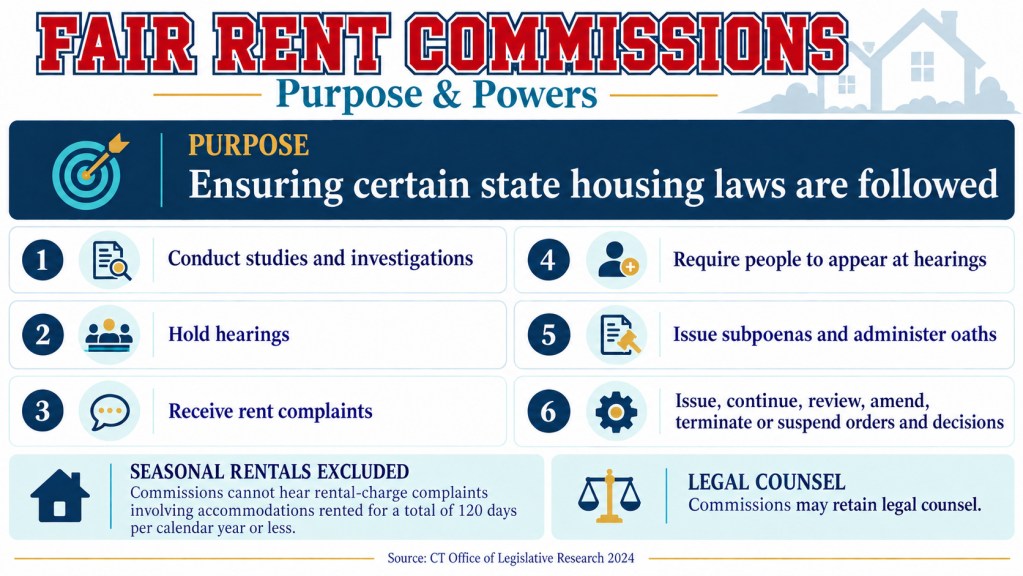
Fair rent commissions are designed to make sure landlords are following certain housing laws.
The commissions “prohibit landlords from increasing rent as a retaliatory action,” according to a 2024 report from the state Office of Legislative Research (OLR).
The commissions are also charged with preventing excessive rental charges, as defined in state law. They can also make sure that landlords comply with the state law that requires at least 45 days written notice of rent increases.
The flyer below was created by this publication on Chat GPT using info from the 2024 OLR report.
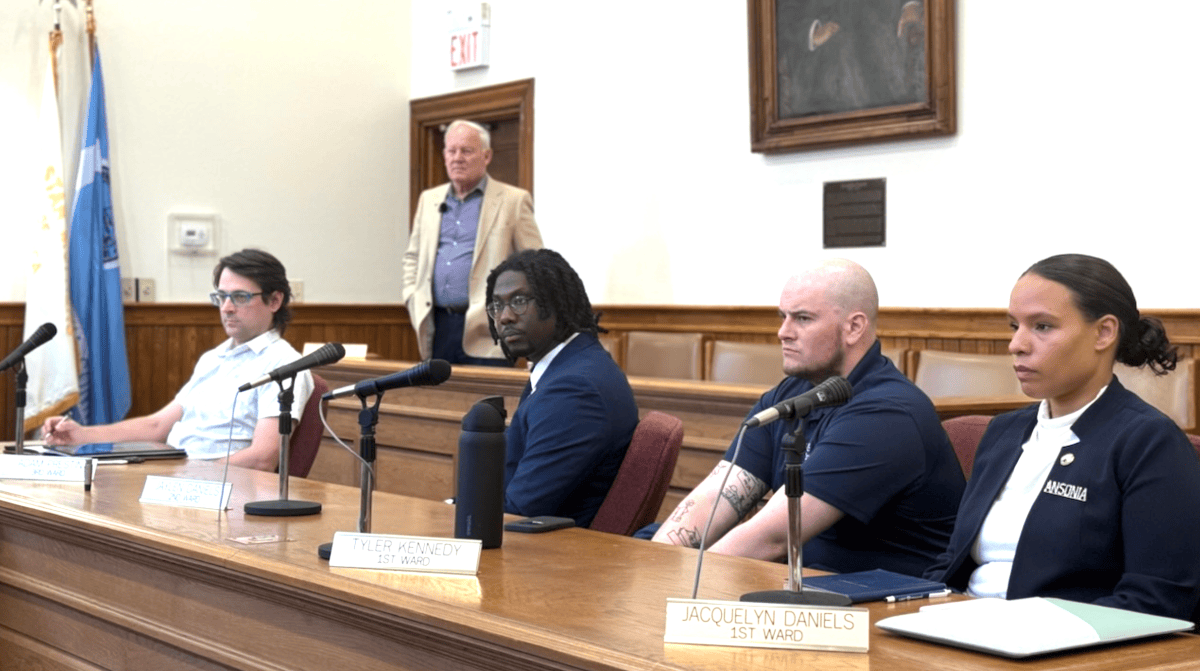
Jaylen Daniels, an Alderman representing the Second Ward who proposed the ordinance that would create the commission, said a local fair rent commission would not have the same power as something like the New York City Rent Guidelines Board.
That board can set rent limits on rent-stabilized apartments in New York City.
“It’s nothing like that. The fair rent commission is a board comprised of tenants, landlords and homeowners with the express intent of trying to prevent unfair rent increases on an individual, case-by-case level,” Daniels said.
However, Dana Haigh, the chairman of the Ansonia Republican Town Committee, said the commission as proposed would risk driving small landlords out of the market and cause price increases for everyone.
“My concern is that a policy intended to improve housing affordability could ultimately make housing more expensive and less available,” Haigh said.
What The Law Says
To meet the state mandate, Ansonia can either establish its own commission, join an existing regional commission, or create a regional commission with other cities and towns.
The ordinance proposed by Daniels would establish a seven-member city commission, with its members appointed by the mayor and approved by the Board of Aldermen.
The membership would be required to include two landlords, two tenants, and three city residents who are neither landlords nor tenants.
The commission would hear complaints from tenants regarding alleged unfair rent increases and violations of state housing laws. It would have the power to set fines against landlords who violate the law and to reduce rents it deems excessive.
You can view the full proposed ordinance at this link.
The ordinance also includes a few provisions which would be unique to Ansonia. Those provisions are:
- Landlords with three or fewer units would receive smaller fines than landlords with more units
- Landlords would be asked to bring paperwork to hearings, including lease/rental agreements, rental charge history, and documentation of costs including property taxes and improvements
- The commission would send reports to the mayor and Board of Aldermen.
Specifics To Be Hashed Out
The ordinance was discussed at an Oct. 6 meeting of the ordinance committee, a subcommittee of the Board of Aldermen. Although members voted to schedule a public hearing in the future, they did not set a date.
The Ansonia Republican Town Committee made a series of Facebook posts concerning the ordinance, saying that the fair rent commission would hurt homeowners and small landlords in town.
Haigh, the Republican chairman, said costs are high for small landlords and that adding a layer of government would drive those costs higher.
“Small landlords are already dealing with rising property taxes, insurance premiums, and maintenance costs,” Haigh said.
Daniels said that the law is written to ensure that small landlords are given a fair shake.
“I added a separate, small landlord tier, because I knew that there was a lot of single-family landlords that live within their houses,” Daniels said.
The Alderman said too many longtime Ansonia residents are being forced out of the city because rental properties are being purchased by out-of-state landlords who jack up the rent.
The Data
Housing is expensive in Ansonia and the state as a whole.
About 51 percent of Ansonia households were living below the basic-cost-of-living threshold defined in The United Way’s annual “ALICE” report.
The 2022 Valley Community Index specifically mentions rising rents as a problem in the lower Naugatuck Valley on page 11. It does not make the connection to out-of-state ownership, but notes increasing rents were forcing people out.
“During the past year, many renters have seen double-digit percentage increases in their rents, which may explain why communities such as Ansonia experience high rates of transiency,” according to the report.
About 12 percent of Ansonia’s rental properties are owned by out-of-state buyers, according to state appraisal data cited by Daniels. That’s slightly higher than nearby towns, including Shelton (10 percent), Derby (9 percent) and Seymour (9 percent).
“We have a lot of decaying properties. A lot of the properties here in Ansonia are attractive to outside investors, many of which are out of state, and they’ve been buying up stuff, up and down the Valley,” Daniels said. “That’s just the reality of life, and people who have lived in Ansonia for so many years are now getting pushed out. And I hate to see that happen.”
Haigh said city government is moving too quickly to create the commission. He noted that Ansonia has until 2028 to comply with the state law, and said it should use that time to figure out the best way to comply.
“The state has given municipalities until January 2028 to comply,” Haigh said. “What is the urgency, and why aren’t we taking more time to evaluate the financial and economic consequences?”
Daniels said it doesn’t make sense to wait until the deadline to comply with the law.
“I’d rather have Ansonia make theirs first to be ahead of the curve, instead of waiting all the way until 2028 to decide,” he said.
One Ansonia GOP Facebook post included a black-and-white photo of Daniels and pointed to the fact that he isn’t a homeowner.
“It’s always funny how those who don’t pay taxes want to tell you the taxpayer, what should happen with your hard earned money and how much you need to give to big government,” the post says.
Daniels said in response to the post that he does pay property taxes, in the form of rent.
“The amount of renters in Ansonia is about 41 percent. If taxes do or don’t go up, the cost of taxes gets pushed over to the tenants regardless,” Daniels said. “At the end of the day, me as a tenant, I still pay property taxes. It’s just vicariously through my landlord. Everyone pays property taxes in Ansonia, even if our names aren’t directly on it.”
What’s Ansonia’s Average Rent?
The average rent in Ansonia could be between $1,800 and $2,000, based on two different estimates.
In 2025, the fair market rent in Ansonia was $1,895, according to the Valley Community Index.
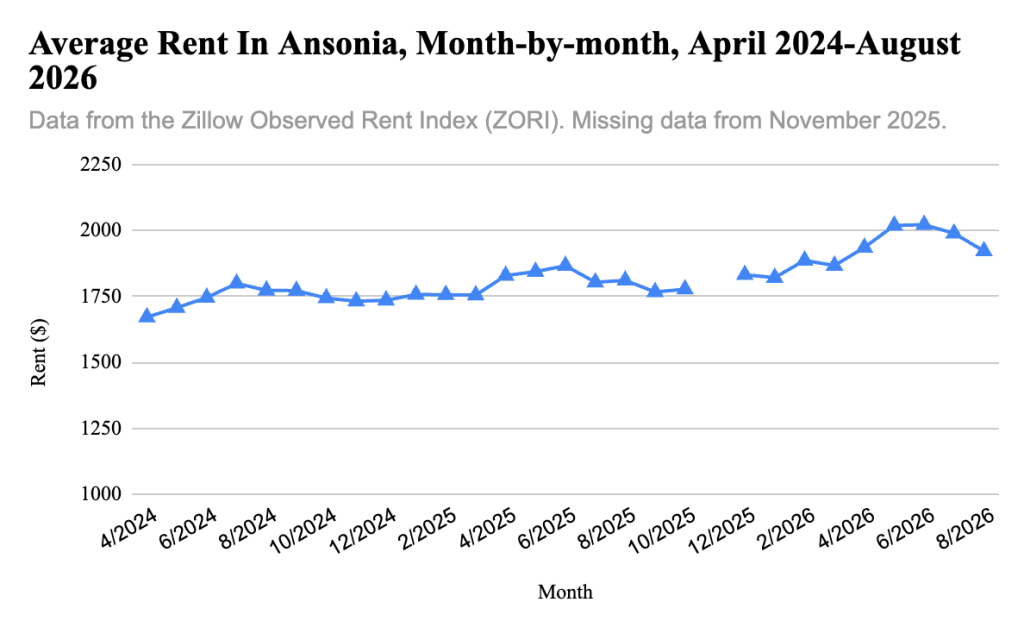
The Zillow Observed Rent Index measures market-rate rents based on Zillow listings and census data. The average rent in Ansonia in August was about $1,920, according to that index.
The graph below shows the change in average rents in Ansonia over the last two years, based on data from the Zillow Observed Rent Index. The average monthly rent has increased by about $250 since April 2024, according to that data.